Showing posts with label pollution. Show all posts

2011/03/02

When the going gets tough, the tough go shopping

This post covers 5-8 October, 2010.

One of the things on my to-do list for the trip was some shopping. Books, CDs, some musical accessories (like strings for my Chinese instruments), and clothing were on the list. The Xidan area west of Tiananmen Square features one of the city's biggest bookstores as well as several buildings filled with clothing shops. Plus it was two stops away on the subway.

It being a national holiday, lots of people were off work and had the same idea I did.


The big sign there says 民族大世界 (Great Ethnic World, I suppose), so you might expect to find a bunch of craft shops and ethnic food stalls inside. You would be wrong. It's a huge area filled with vendors hawking clothes, shoes, bags, and so on, all for prices low enough that you have to suspect counterfeits. I wandered around in there, but didn't buy anything. Across the street is a newer, more reputable shopping center.
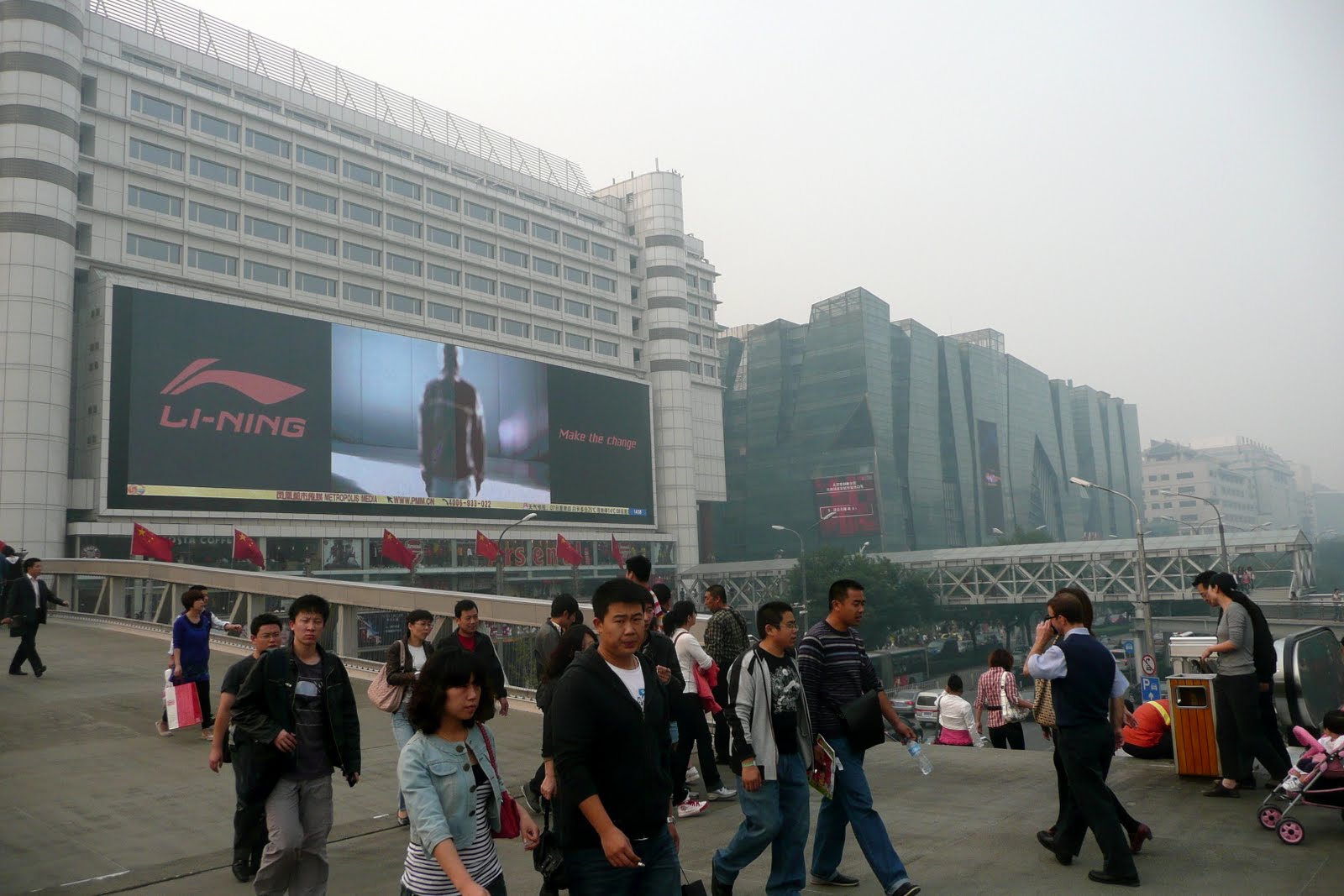

That's a giant video screen across the front of the building. It shows nothing but advertisements. I took this picture standing on the pedestrian bridge over the street, so we're at the second floor level. That's the place where I bought all my Astro Boy gear. There are about six levels of shopping in the building, then a level that has a gaming arcade, and then a few floors of offices above that. I have a friend who works upstairs there. Note the interesting design of the next building on the left.

Also notice that the air doesn't look nearly as clear as it did in the previous pictures. Those were taken on Tuesday, and by Thursday the air was getting a little thick.

Standing in the spot where I took that last picture, I turned to face south and snapped this one.


Yeah, it was a pretty hazy day. At the right side of the frame you can see the edge of the Bank of China headquarters, where I attended a few meetings when I was working in Beijing. Further south are more banks and office buildings - the shopping district is all to the north.

One of my favorite restaurants is near here, a short walk into the old residential area north of the bookstore. One evening I met a couple of friends for dinner there, and I swear the head waiter remembered me from the many times I've been there before, even though it had been over a year since my last visit.


We had 香锅 (Fragrant Pot), which is kind of like hotpot except that they do the cooking for you and serve it dry. You choose your ingredients from a big list. We had chicken (the other choice is fish) along with a couple different kinds of mushroom, noodles, tofu, carrot, and 山药 (shanyao, literally mountain medicine, a kind of root vegetable). Plus a pile of hot peppers and a few other things that make up the "fragrant" part. It's pretty spicy, and my stomach always punishes me the next day for eating it, but it's soooo tasty.

2009/07/30

What I like about you (from the other side)

Only one day left until I leave Beijing, and already the apartment is getting echoey. I’ve given away a bunch of stuff, and packed other things. The movers came yesterday and took away many boxes – I’m really glad I didn’t have to do it all myself.

Before I left Seattle, I made a list of things I thought I would miss and not miss about the city, so now it’s time for the same list about Beijing.

Things I will miss about Beijing

  • My friends.
  • The food, both in quality and price. And it’s cool you can have roast duck without planning ahead.
  • The ancient culture that is never far away.
  • Ease of transportation. Between my bicycle, the subway, and buses, getting around is generally quite convenient, even with the ridiculous traffic.
  • The chance to practice speaking Chinese with native speakers every day.
  • How amazing it can look after a good rain.
  • The sense of freedom you have when you don’t have to worry about crime.
  • How cheap things are if you’re looking for cheap things.
  • Having someone come clean the apartment twice a week.
  • The challenge of trying to think of ways to explain English words and expressions.
  • The vibrant music scene and all the great bands here, plus the ones I haven’t discovered yet.

Things I will not miss about Beijing

  • The quality of the air, and I’m not just talking about the odd odors that sneak in occasionally when the breeze changes direction.
  • The bone-chilling winter temperatures.
  • The energy-sapping summer temperatures.
  • The Great Fire Wall.
  • The ridiculous traffic.
  • Office politics.
  • The hideous desk my landlord provided for my computer.
  • The hassle it can often be to deal with seemingly simple things like electricity, mobile phones and internet.
  • Having to register with the local police station so they know where I am.
  • The feelings I have on the occasions when I do think about politics.
  • Never really understanding what’s going on, even when I think I do. Not that this is necessarily different from the situation in the US...

In a very unusual bit of luck, I have never really experienced one of the famous Beijing spring sandstorms, so that didn’t make either list.

Final note

I created this blog when I found out I was coming to China, and now that I’m leaving, I’m not sure what I want to do. In the interest of keeping it to its topic (not that I’ve stuck to it strictly so far!), I don’t really want to continue writing about my life as it involves things other than China. However, I still have lots of China experiences and pictures I haven’t shared, so there’s material for many posts waiting for me to have the time to take care of it.

2008/10/18

I Gotta Get outta This Place

If there was any chance I was regretting the choice to make a quick trip back to Seattle now, this sealed it:
That’s what it looked like at 8am from my window this morning. Obviously the good air we had during the Olympics is nothing but a memory.

For comparison, here’s the same view on a reasonable day (29 December 2007):
Then again, it’s 8am and my flight leaves at 4:20pm and I haven’t even started packing. I’m trying the new direct Beijing-Seattle flight on Hainan Air. Saves a lot of time, but I was kind of liking the relatively easy Customs experience in Vancouver. We’ll see.

2008/07/05

Eight great sights

On the bus ride out to Xiangshan Park, I saw the entrance to another park that looked interesting. It’s called Badachu (Eight Great Sites) and features eight Buddhist temples spread about on three hills (so they say – seemed like one big hill to me). As with many other historical areas here, it was partially destroyed by the Eight-Power Allied Forces in 1900 and has since been restored.

Once again, it was a combination of subway (to Xizhimen) and bus to get there. The weather was particularly unscenic, but not actually raining, at least early in the day. Ironically, it seems that this summer has averaged much worse air quality than last summer, with far fewer clear days. It’s also rained a lot more.
I think that from this position, you should be able to see a hill in the background.

Just inside the entrance (¥10 or about $1.50) there is a waterway choked with lotus, some of which are in bloom:
Moving further along, you see the first temple. At least the first temple you get to – I’m not sure of the official numbering order. This is the Pagoda of the Buddha’s Tooth, part of Lingguangsi (the Temple of Divine Light). It is said to contain one of the four teeth found in the ashes when the Buddha was cremated.
Although it wasn’t very far away, it was largely obscured by haze. The rails of the stairway are decorated with lions, each of which is different:
The dragons are cool too.

Here’s a closer view.
In addition to incense, there are tables burning lotus-shaped candles.
In addition to lions, there are also statues of elephants.
A little further up the hill you come to a dragon-themed area.
For an extra ¥3 you can go in to see this:
It is a single piece of black stone (called “inkstone”) carved into a writhing mass of dragons.
It is not ancient, but carved recently, and took seven years to complete. It’s nice to know some of the traditional arts are still being done well in modern China. It is one of the most impressive things I have seen in China.

A bit further up the hill, there’s a resting area with some old stupa.
It was about here that it started sprinkling. Luckily, there was a refreshment stand that had a few cheap umbrellas for sale.

Sanshan’an (Three Hill Nunnery) is the next temple, and it is home to some cats.
The path up the hill was a bit slippery at times in the rain.
A little further along, you could hear music up in the trees.
It was a blind accordionist. He honestly wasn’t very good, but I really admired how he had come all the way up the hill to do his thing, so I dropped a few kuai in his bucket.

Here is temple number five:
The big characters on the sign say Cai Shen, which is the name of a famous historical figure noted for his generosity. Visiting this temple is said to bring good fortune.

From there on the trail got very steep:
Just kidding. That’s not the path.

A little further along is another temple (of course).
The writing says, Wu fang shijie, shi fang fo, fu du tianxia guanguangke. Which I really can’t make sense of, though I know several of the words. Something about the world and the Buddha. Guanguangke means tourist, which seems an odd thing to find in such a place. I’m open to suggestions.

Under the letters you can see part of a large round rock, under which is a little cave where a holy man is said to have lived for 40 years. It now contains a Buddha statue with many candles.
The temple just above the letters is said to have the best view out from the height. Not on this day.

After reaching the top, heading back down by a different path led to this:
This oddly decorated boulder is at the lower entrance to a gully filled with carved stones. Near one of the other stones is a plaque explaining how the rocks were left behind after the icebergs (that’s the word used) receded from the area at the end of the last Ice Age. They’re called “glacial erratics” in English.

So that’s Badachu. Maybe not one of the more famous Beijing destinations, but quite nice, and possibly even spectacular on a clear day.

2008/06/18

Running up that hill

West of Beijing’s flat expanse rise some prominent hills. The Summer Palace is close to their base, and you can see them in some of my pictures from there.
(from April 2007)
Given the city’s long history and the significant portion of it when it was an imperial capital, it’s not surprising that emperors took an interest in these hills. Beijing’s climate is notoriously unpleasant at many times of the year, which encourages those with the means to get out of town. Add to that the fact that it’s really pretty up there, and you can bet the rulers appropriated big chunks of it for their personal use.

The park today called Xiangshan (Fragrant Hills) is one of those chunks. According to the brochure, it dates back to the Jin Dynasty in 1186. It has served as a royal resort for summer hunting and other activities for other subsequent dynasties based here. The famous emperor Qianlong ordered much expansion and building in 1745. And like many ancient things here, it’s had a variety of different names through the ages.

As with the Old Summer Palace, much damage was done to Xiangshan by English and French armies in 1860 and by the allies of the Boxer Rebellion in 1900. It was opened as a public park in the 50s, and much of the destruction has been restored.

It’s quite a distance from the center of town. Taking the subway to the closest point still leaves you a bus ride of an hour or so.
The second bus is the one to Xiangshan, and almost all of the people were waiting for it. Note that although it appears warm, the sky is a uniform color that is not blue.
This is the park entrance, with the titular hills behind it. The highest one, on the right, is where I’m headed. Beijing’s elevation is 143 feet, and the top is at 1827.
This is half of Yanjing Hu (Spectacle Lake – spectacle as in eyeglasses) with a little artificial waterfall. From near here, there is a cable car to take you to the summit, but that’s for wimps, and I’m not a wimp.
If I remember right, this is the front of an old monastery (this part of the brochure is only in Chinese, and not any characters I know). I think it was built by the emperor for when the Lama visited from Tibet. I like the tree growing out of the wall.
This is Liulita (Glazed Tile Pagoda, pronounced oddly like “Lolita”), which managed to survive the destruction while most everything else went down.
From there on, it gets kind of steep. This is one tiny fraction of what seemed like an endless stairway. By this point I was starting to wonder if the cable car might have been a better choice. But imagine the feeling of accomplishment that lies ahead!
Yes, that’s the top way up there. Would it take longer to go back down and catch a ride?
There is even some wildlife to be seen.
Very near the summit now, seriously out of breath and thankful for the extra bottle of water I bought from a lady a few hundred meters below. Notice how people react to a sign that says Dangerous! No coming close! And no, that is not the Great Wall in the background, just an old park boundary fence.
This is the top. Finally made it. My legs were on fire, but I can now count myself among those elite few who have done the climb. All ten million or so of us.
You’ll have to take my word for it that Beijing is down there. The air at this height is actually pretty good, and we were in bright sunlight. The “haze” was so diffuse that you couldn’t see it in a layer from this height.

After a lengthy breather, it was time to head back down, which involves a somewhat different set of leg muscles. Equal opportunity aches, you could say.
It’s quite a pleasant spot for a picnic or just relaxing. The park is most famous for its fall colors, with a number of different species of trees contributing. I’ve heard it can be extremely crowded at that time of year. But it’s pretty nice in early summer as well.

As you can tell, when I went up this hill, I was not running, but I couldn’t resist a Kate Bush reference for the title. But I am not a wimp.

For some shots of Xiangshan on a clearer day, check out this page. Just my luck, the day after I went was clear and blue, at least in the morning – thunderstorm at night.

2008/03/16

The New High March

Looking back to 9 March, I find a bunch of pictures that never made their way onto the blog. Time to take care of that oversight.

With the weather turning nicer finally, I thought I’d take a walk. I had the ostensible purpose of finding some light bulbs for my bathroom – they’re an unusual kind I haven’t found in a store nearby – but I really just wanted to see a neighborhood I haven’t covered yet.

I rode the subway a couple stops north on Line 13 and got off to walk along the Third Ring Road. It’s a district of block after block of apartments.
As you can see, it wasn’t the clearest of days. But at least it wasn’t cold.
This is one of the typical incongruous sights you see here. I am not sure how toucans and ax-wielding winged Chinese figures go together, but there they are. I also wonder where they came up with the name Glidous.
After a while I came to a second canal, this one a little more appealing in appearance. I personally wouldn’t go so far as to swim in it, but this guy did.
This is a little park called Tuanjiehu (I looked it up, and tuanjie means unity; I already knew that hu is one word for lake). There was a sign explaining its history in Chinese and English, but it was so incoherent I couldn’t make much sense of it. Something about a kiln being torn down and turned into a lake. Must have been a pretty big kiln.
Some of the skaters were pretty good. There were also bumper cars and other small rides as well as pedal boat rentals for the lake.
The park is in the midst of a rapidly developing district of high-tech office towers.

And a few blocks south, you catch a glimpse of the highest-tech of them all.
That’s the new headquarters of China Central Television.
And for now, just one more shot of this unnatural wonder.
It would seem that the government here, in addition to developing technology that can miraculously filter the whole internet, can filter gravity as well, at least in this vicinity.

You’ve seen the highest-tech, and not too far to the west of there is the highest-rise.
China World Trade Center Tower 3, which I’ve mentioned before. It’s probably already the tallest building in Beijing.

By this time, I was pretty tired. I’d covered about ten kilometers, and just about when I was ready to fall over, I stumbled across Tim’s Texas Roadhouse. A burger and a caipirinha helped revive me. Oddly enough, the drink was made with lemons instead of limes – I probably should have stuck with Tim’s specialty, the margarita.

It was getting dark, so no more pictures. On my way from Tim’s to the subway station, I heard a screech and a thump, and looked over to see a man laying in the street and a little van stopping. There was a pile of collapsed cardboard boxes scattered around the man. He had tried to get across the street in the middle of the block against the light. He didn’t seem to be badly hurt; he was getting to his feet before long.

I’ll leave you with one last picture. It’s an advertisement on the back of a taxi seat.
If you’re wondering why I would take interest in such a thing, consider this. The fruit known in America as kiwi was previously known as yangtao, scientific name Actinidia chinensis. Notice the second word there – does it remind you of any country? It originally had an English name of Chinese gooseberry. Yes, it is native to China. (I’m not completely sure about that Chinese name, since mihoutao is the Mandarin name I learned. But Mandarin is a Northern Chinese language, while the kiwi is native to Southern China, so no doubt the people who grew it there called it something else, perhaps yangtao, as mentioned on the Zespri site.) In any case, as the story goes, the fruit was taken to New Zealand in the early Twentieth Century, where it became a commercial crop, and they named it kiwi in order to sell it in other countries. And now the New Zealanders are selling Chinese fruit back to the Chinese! In all fairness, you might notice that some of the kiwis in the picture are yellow instead of green inside. They’ve developed a new variety that supposedly tastes different. I haven’t had one of these yet.

Oh, my. Now I’m really rambling. Must be time for bed.

By the way, I never did buy any light bulbs.