Showing posts with label 摇滚. Show all posts

2011/01/31

The Dianying Diaries, part 4

Part of a series dealing with Chinese cinema. 电影 (diànyǐng) is the Chinese word for movie, the two characters literally meaning “electric” and “shadow.”

北京乐与路 (Beijing Rocks)


This
2001 movie was a Hong Kong production filmed in Beijing and other parts of Mainland China. It was directed by Mabel Cheung (张婉婷), who is one of Hong Kong's most prominent directors. The story concerns a struggling singer-songwriter named Michael Wu (played by 吴彦祖 Daniel Wu) from Hong Kong who goes to Beijing to find inspiration and learn Mandarin, which is increasingly necessary in the Asian music market.

Back in Hong Kong, Michael's father is a wealthy businessman who is paying for his son's expenses during his creative dry spell. The senior Mr Wu owns a large beautiful courtyard home in an old hutong neighborhood, where Michael, along with his father's mistress, stays in Beijing. In addition to his songwriting, Michael plays in a rock band called the Mexican Jumping Beans, though he says playing rock in HK is a money-losing proposition. So in addition to brushing up on his Mandarin, Michael hopes to dip into Beijing's rock scene.


The other important part of the back story is that Michael is in trouble with the law. There are vague references to some kind of altercation in a Beijing pool hall and the fact that Michael's father has bailed him out of jail and is trying to pull strings on his son's behalf. So it's probably not a smart idea for him to be hanging out in a gritty rock club on the night the plot gets rolling.


Beans are frying in a beanstalk fire
Out from the pan, the beans sadly cry:
"We sprang from the same root, brother
Why do you give me such a hard time?"

The band on stage is called Moonwatchers, and things start going wrong when the club manager cuts off the lead singer's mic for some reason. The singer gets angry, stops the band, and starts yelling at the manager. A fight ensues, and it ends with the musicians and a couple of girlfriends grabbing as much of their gear as they can and climbing out the windows as the police arrive.


Michael picks up a pair of dropped drumsticks and follows them, finally catching up with them at the kind of cheap hotpot joint that can be found all over Beijing. Much drinking follows as Michael meets this bunch of social misfits who love to make noise and use nicknames. The lead singer is called
平路 (Road, played by 耿乐 Geng Le), and he takes a liking to Michael, though they all mostly refer to him as "Hong Kong Peasant" and make fun of his terrible Mandarin. Road's girlfriend is 杨颖 (Yang Ying, played by 舒淇 Shu Qi, who I think is one of the most beautiful actresses from China, Taiwan, or anywhere else).

The rockers teach Michael how to drink 二锅头 (erguotou, a potent alcohol) in a way I haven't seen done: mix it with Sprite and slam the glass on the table to make it fizz, then pour it down your throat as fast as you can. After a few of those, they pass around a couple joints Michael brought and get very happy.


Michael really likes these people, especially Yang Ying (who wouldn't?), and when his father shows up in Beijing, he packs a duffel bag, grabs his bass, and sets off to find them. They live and practice in a squallid, run-down neighborhood somewhere on the outskirts of Beijing. Ying makes a little bit of money working as a dancer in a cabaret of questionable legality.


As far as I can tell, the girls don't actually strip, just tease, which leads to trouble with the rough crowd one evening when Michael happens to stop by to watch. A nasty looking group of men comes up on stage demanding that the girls strip; Ying hits one of them, causing a big gash on the side of his head, and before long the police are carting the whole gang off. The sideshow manager manages to negotiate Ying's fine down to 5000RMB, but she's locked up in a crowded cell full of women for assault.


As we know, Michael has a rebellious streak, and is currently avoiding his father, so when the sideshow and the rock band decide to go "hole-hopping" (hitting the road without permits), he talks them into letting him come along. They all pile into a rickety old bus and head for the provinces, dancers, jugglers, rock band and all.


One of the unusual things about the movie is the occasional soliloquies by the characters, a bit like the candid interview bits we see on "reality" shows.

As the character talks about their dreams or whatever, there is goofy animation behind them illustrating the words.

At various times during their journeys, Ying and Road get into fights, and they usually end with her stomping out of their tent and spending the night under a tree or wherever. Michael tries to comfort her, and discovers that in spite of the friction, she sees Road as her soul-mate.


The band plays in a variety of poor villages to a mixture of baffled workers and dancing kids, though usually their music doesn't go over especially well. Road's lyrics seem to be pretty heady stuff, mixing Buddhist mysticism with social rebellion.
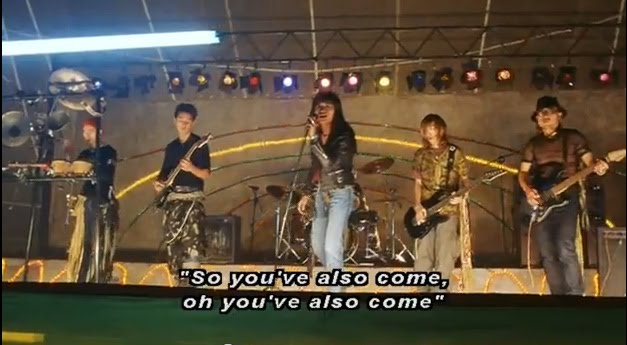

At one show, Road's father steps into the tent, causing him to stop singing and disappear. Michael saves the performers from an unhappy mob by starting to play 月亮代表我的心 (The Moon Represents My Heart), a famous old Chinese pop song. The rest of the band comes in to provide a rock background as Ying sings the familiar words.


Somehow, during the midst of all this, Road rides his motorcycle back to Beijing to meet with some record label people about signing the band. They don't care for his music or his attitude, and tell him that the rebelliousness of their other rock bands is mere marketing; in truth they are good corporate employees who do what management tells them.


While he's gone, Michael takes the opportunity to spend some time with Ying.


But Road's return puts an end to that. And Road is especially surly after his meeting in Beijing, though he doesn't tell anyone what's going on. He just keeps saying, "I signed it. It's all over."

That's as far as I'll go with the plot. Let's just say the story does not get a happy ending. We find out what really happened in the pool hall before Michael got arrested; and what the consequences will be.


Obviously, there's a lot of music in the film, but only some of it is rock. In fact, it's a little jarring sometimes when the soundtrack swells up with a typical orchestral cue; I wish they'd stuck with the rock theme. When the band is playing live, the mix is often very strange, with the vocals unusually prominent and the guitars rather quiet. I suppose this helps to heighten the focus of Road's creativity and thoughts. In addition to the Moonwatchers' music and the soundtrack, I recognized 唐朝 Tang Dynasty's version of "The Internationale" on the soundtrack, and I believe there are other bands represented as well.


While much of the film seems pretty down-to-earth, I wonder about the portrayal of country folk, which might be considered stereotypical: dirty, unsophisticated, crude, and money-hungry. Local officials like policemen are shown as easily bribed and manipulated.


Other examples of stereotypical characters include Michael's father, who is a slimy lizard more concerned about private pleasure and public image, and throwing his money around, than in his son's happiness. (On the other hand, this seems completely realistic.) And then there are the record company guys, who were totally fake in their fashionable clothes and sneering attitude. (Which again seems totally realistic!)

The editing is a little strange, though completely consistent with the rock idiom. Michael often carries around a little camcorder, and his footage is mixed in with the movie's normal film. The inclusion of the eyes-to-the-camera interview bits with animation takes us a bit outside the story, which serves to emphasize the fact that these characters do not entirely live in the same world as the "normal" people around them.

The jail where Ying spends a little time is really nasty, with a big, dirty cement room filled with women wrapped up in blankets on the floor. The women are made to recite the jail rules in unison in the morning.

There's a lot of swearing, and the language in general is very slangy, with lots of thick accents I found difficult to understand, so I had to rely on the subtitles.


All in all, I enjoyed this movie a lot. It's a fascinating picture of a part of Chinese life we don't see much of, in spite of the rash of documentaries you can find about the Beijing rock scene, all of which are more current, whereas this covers a bit older time period.

This body is a bodhi tree
And the mind a mirror bright,
Carefully we wipe them hour by hour
And let no dust ever alight.
So Buddha says:
If I don't go into hell, who will?

There is no bodhi tree
Nor stand of a mirror bright,
Since all is void
Where can the dust alight?
So I say:
So you say:
So he says:
So Buddha says:
If I don't go into hell, who will?
Wikipedia entry
IMDB entry

It is available from Netflix.

2010/06/02

The Yaogun Diaries, part 7

Part of a series dealing with rock music in China, mostly Beijing because that's what I know. 摇滚 (yáogǔn) is the Chinese word for rock music, the two characters literally meaning "shake" and "roll".

Buyi (布衣)

Touching on another facet of rock music in China, I’m going to focus on another of my favorites, Buyi (布衣). Their name means “cloth” and the term is used to distinguish ordinary fabric like cotton from fancy stuff like silk. In keeping with this deliberately humble name, their music is perhaps unassuming, but full of passion and an appreciation for the plight of ordinary people. The band originally hails from Ningxia (宁夏) , formally known as the Ningxia Hui Autonomous Region, a relatively small province in north central China (generally referred to as “northwest” given the coastal bias of the Chinese). It is the home of the Hui ethnic group, typically Islamic Chinese speakers. (In standard PRC fashion, the Hui only comprise about a third of their own Region’s population, with Han Chinese being the majority.)
A promo shot with a previous drummer.

Buyi’s niche is combining Chinese folk music with rock (plus a bit of the Western singer/songwriter tradition), and they’ve been around since 1995; they relocated to Beijing in 1999, and have remained a staple of the capital’s scene ever since. The constants in the band thus far have been lead singer and guitarist Wu Ningyue (吴宁越) and Zhang Wei (张巍), who plays guitar and guzheng. There has been some turnover at the bass and drum positions (purportedly a total of more than ten players). Wu claims to have been influenced by Cui Jian (崔健) along with such Western artists as the Rolling Stones, Aerosmith, and Nirvana.
Buyi live at 2 Kolegas, 2008-06-27.

I first encountered this band from articles about them in Beijing’s English language press, and when I first saw them live, I knew the acclaim was well-earned. Wu is a friendly presence on stage, chatting and joking (though of course I can’t understand a lot of what he says); the band plays very naturally, completely comfortable regardless of the situation – no doubt due to their long history and appearances at major festivals. I caught them first at 2 Kolegas in June of 2008 and posted a few pictures here. While there I picked up all the CDs they had available at the time, which included a self-titled collection that might best be characterized as demos, their then current studio album, and a live album.
Wu Ningyue doing the folk-rock thing at 2 Kolegas, 2008-06-27.

The oldest recordings are apparently not considered an official release, but they’re certainly worth hearing. There's no title listed, so I call it jut Buyi. It's a CD-R with no date on it, but I believe it dates from 2004.
It's a mixture of studio/demo recordings and live tracks. Here is one of the highlights, 为你唱首歌 ("Sing a Song for You").

"Wei ni chang shou ge"

The band’s first proper release was 那么久 (That Long), recorded in 2007.
In an interview with The Beijiner, Wu said that the recording was plagued by budgetary constraints and disagreements with the record label, resulting in a sound that “wasn’t unified” but I’ve always found it a great set of tunes, surprisingly polished sounding considering the band’s reputation. It opens with the superb title track, with anthemic electric guitars and a soaring melody on the guzheng.

“Name jiu”

It's kind of a sad song, in case you can't tell from the sound. There are only a few lines of lyrics repeated a number of times: "Time has been so long, the skies have been grey so long, and pain is on every side, and my dreams are behind me, so long after so long."

"Yang rou mian"

And this one is 羊肉面 ("Mutton Noodles"), an ode to a childhood comfort food.

On their 2008 live album 喝不完的酒 (Endless Wine), they revisit a few tunes from previous recordings as well as a few unfamiliar (to me) songs. With well over ten years of material to draw from, there’s no shortage of songs.

Apparently, it was released in a limited edition of only 1000 or so copies, so I guess I’m lucky to have one. It features four songs from That Long, two from the self-titled debut, and six others. 不累 ("Not Tired") is a perennial favorite from their live shows.

Bu lei

And here's a video of the same tune. I did say it's a perennial favorite.


The second time I saw Buyi live was in a very different situation from the cozy brick room at 2 Kolegas. They were part of a festival called the Thirteenth Month Festival, playing on a Sunday evening. Due to a mixup in the show’s start time, I missed most of their set (you can read about it here). They were on the huge stage at the Beijing National Convention Center, complete with full light rigging, video screens, and room to move around without bumping into one another.

Buyi on the big stage at the 13th Month Festival, 2008-06-29.

They had the opening spot for 苏阳 (Su Yang) and 郑钧 (Zheng Jun), two well-known Chinese rock artists. The little I heard sounded pretty much exactly like the live album. I think they finished with Bu lei (Not Tired).

Later in 2008 they released a live DVD, but I haven't seen it. It has the songs from the live CD plus a few more. Next time I have the chance, I'll have to get myself a copy.

The next Buyi show was my first time at 将进酒吧 (Jiangjinjiu Bar). It’s a tiny little place located between the Drum and Bell Towers, and it was so packed my friend and I ended up hearing most of the show from upstairs, where we couldn’t see the band at all. I think we were sitting directly above them with a couple layers of wood in between.

Buyi and way too many people at Jiangjinjiu, 2009-02-14.

I ventured downstairs to take a look and some pictures, and found a crowd that surely violated some kind of fire code crowded around a tiny performance area (not a raised platform at all). Buyi plays here often.

Barely room for Buyi at Jiangjinjiu Bar, 2009-02-14.

It was a cold night outside, but inside Jingjinjiu it was steamy and stifling, full of sweat and cigarette smoke. The band seemed to be in their element, and the crowd seemed to know every song inside out. They finished with one I had never heard before, which had my companion laughing and looking a little embarrassed. Most of the audience sang along with the whole song, especially the choruses and “la-la” sections.

Buyi doing "Roman Watch" at Jiangjinjiu Bar (though not on the same night I saw them there).

After we left the bar, my friend explained to me a little about the song. She said the lyrics were very dirty (which maybe explained why it wasn’t on any of the CDs I had), and involved the story of a couple with money problems. The boy decides to buy the girl a nice watch as a gift, but can’t afford it, so he steals it. He gets caught, and instead of being supportive, she abandons him. As he’s carted off to jail, he shouts a string of insults at her. These make up the chorus of the song. Years later, he’s out of jail, and somehow the situation arises that she needs his help, but he tells her where to stuff that idea, and she yells the same set of insults back at him. At least that’s what I got out of an explanation from a non-native English speaker who had only heard the song once very late at night after who knows how many drinks. I could have it completely wrong, and she could have been wrong as well – though I’m almost certain there’s a watch involved.

When I saw them again, it was back at 2 Kolegas, this time outdoors under a canopy. Although there was a drum kit present, Buyi’s performance ended up being just the duo of Wu and Zhang.

Casual acoustic Buyi at 2 Kolegas, 2009-06-14.

They played stripped-down versions of some Buyi standards, and were joined from time to time by others in a very loose atmosphere.

Zhang Wei on the guzheng at 2 Kolegas, 2009-06-14.

Finally, in 2009, the band released what is usually called (by way of some creative math) their second album; to add to the confusion, it is self-titled, but I suppose the small number of people who have the previous self-titled CD know the band well enough to not be confused.
Barring one track, it’s a studio recording, and features some songs that first appeared in live form on Endless Wine. And while Wu has described it as “more hard rock,” I’d say it’s actually got some mellower moments on it than That Long, though the rock tunes do perhaps rock harder, like the studio version of "Not Tired" - but I'll give you something different as a sample for the album.

The CD opens with a lovely mostly-acoustic track called 三疯 ("Three Crazy").

"San feng"

And as a representative of the band's other side, here is 光荣的愤怒 ("Glorious Anger").

"Guangrong de fennu"

To my surprise, the final track on the album is a live recording of 罗马表 (“Roman Watch”), the very song they finished with at Jiangjinjiu. It was fun working my way through the lyrics to see just how right or wrong I was about them. The first part is pretty close, with a boy whose girlfriend has high expectations; he steals money to buy her a “Roman Watch,” and gets caught. She just laughs at him; he says something rude to her, finishing “I did everything for you.”

The second verse actually seems to be about a completely different situation (or maybe it’s the same girl with a different guy). It's from a girl's viewpoint: she says her boyfriend has high expectations, and likes a girl who is well endowed, but she is flat-chested. So she goes to have surgery, but the surgery fails; the boyfriend just laughs at her; she says something rude to him, finishing, “I did everything for you.”

As to why it can appear on CD in China even though the lyrics are dirty… well, I think that deals with a quirk of the Chinese language. It is a language full of words that sound alike. Many people have heard about why eight is considered a lucky number: it’s because ba (eight) sounds like fa (wealth or prosperity). I’ve mentioned elsewhere in my posts that bats (fu) are considered auspicious because “good fortune” is also pronounced fu. Anyway, one consequence of this is that any dirty word can be replaced by another word that sounds the same but that isn’t dirty. Technically, no swearing is involved and no laws are violated, but most listeners know exactly what the real meaning is. You find a lot of this on the internet, since it's filtered in China and you can't post dirty words. That's what the whole "Grass Mud Horse" thing is about. So when they sing, "I laugh at your mother's force" (which doesn't really make sense), it's really something different about the mother that is being referenced.

As Iwas doing research for this post, I noticed a page on the band's official site labeled "Download" which has a three-song EP from 2009, including one song sung by bassist Lin Na (still written by Wu Ningyue). But I haven't figured out how to download it yet - if I do, I'll post an update.


Rock in China Wiki entry
Official website

2010/02/05

The Yaogun Diaries, part 5

Part of a series dealing with rock music in China, mostly Beijing because that's what I know. 摇滚 (yáogǔn) is the Chinese word for rock music, the two characters literally meaning "shake" and "roll".

Milk@Coffee

Moving even farther astray from the punkish side of Chinese rock, we find this band, known sometimes by the Chinese version of their name, 牛奶@咖啡 (niúnǎi kāfēi) with the @ often not pronounced. I suppose you could say they’re not a rock band at all (see below for their own take on the question), but I have a pretty broad definition of rock. To pick a Western genre for them, I would probably choose “indie pop” but I don’t regard anything including the word “indie” as an actual genre. They are basically the duo of Fu Yan (富妍), known as Kiki, singing and 格非 (Ge Fei) on keyboards, guitar, programming, and so on. In a live setting other players are added to fill out the sound.

Their first album was called 燃烧吧!小宇宙 (ránshāo ba! xiǎo yǔzhòu), officially translated as Burn! My Cosmos, and came out in 2005.
I really enjoy this happy music, which reminds me of some of the Japanese bands I like. Here’s a track for you to get the idea.

Lasia

This song, called “Lasia” actually garnered them some success in China, apparently hitting #3 on some kind of chart (I can’t find documentation of this, just a reference on Baidu).

There’s also a fun video for the title track of the album:

The first time I saw them live was at the Beijing Pop Festival in September of 2007. You can read my original post here.
By the end of the set, they had a whole bunch of extra people on the stage dancing and singing the chorus of a song that wasn’t on the CD; even then I knew enough Chinese to make out the title “Wo bushi rock ‘n’ roll” which means “I’m Not Rock ‘n’ Roll” – ironic since it was the most rock oriented tune they played.
The next time I saw them live was in a much more controlled setting, MAO Livehouse, in July of 2008 as part of a “girls’ night” featuring all female-led performances. While I didn’t write a review of the show, I did post some pictures. Here’s another one:
I found myself grinning like an idiot pretty much throughout their set. Kiki is so charismatic, cheerful, and cute you would have to be a real grouch to dislike her. There was a charming bit where she brought out a sequined top hat and a sparkly cane to do a little dance. The hat later ended up on the guitarist.

I even took some video of their final number.

Later in 2008 they released their second album, which has the happy title of 越长大越孤单, More Grown up, More Lonely.
When I got it, I was very happy to see it had the song I remembered from their festival performance. 我不是 Rock ‘n’ Roll (I’m Not Rock ‘n’ Roll).

I’m Not Rock ‘n’ Roll

About the same time as the CD came out I saw them again, this time at the Modern Sky Festival. Again, they got only a few photos instead of a full review.
It was a really fun performance, what with the pirate hat and bubble machines and all, and the crowd was so big I couldn’t get anywhere near the stage. This was by far the biggest stage I’ve seen them on, and they had a great time. The backing band was a little different, featuring a female keyboard player to fill in while Ge Fei concentrated on guitar.

In addition to their own CD releases, Milk@Coffee was involved in an interesting little project put together by Modern Sky Records: a CD for children called 星猫 (xīng māo Star Cat).
I hope this project is successful – it will be great to have a generation of kids exposed to music other than sappy pop.

Rock in China entry: http://wiki.rockinchina.com/index.php?title=Milk@Coffee

Note: All images and audio files presented here are in the interest of increasing awareness of Chinese rock in the English-speaking world. If you are the owner of the copyright in any of them and object to this free promotion, let me know and I'll remove the offending media.

2009/11/22

The Yaogun Diaries, part 3.5

Part of a series dealing with rock music in China, mostly Beijing because that's what I know. 摇滚 (yáogǔn) is the Chinese word for rock music, the two characters literally meaning "shake" and "roll".

Hedgehog (Revisited)

When I wrote about this band a few weeks ago, I mentioned that I had never heard, let alone seen, their first album, Happy Idle Kid. Well, due to the help of some readers who commented on that post, I managed to track it down. At one point the band had made it available for a free download, and as we all know, once something is out on the internet, it’s there forever. This one took a lot of searching to find, but it paid off.
I was expecting this to be rather primitive sounding, but aside from the minimal production (which actually works in the music’s favor), this is a good solid effort, and shows the band knew what they were doing even less than a year into their existence.

Buffer

Here’s a track to check out. It starts somewhat quietly with an odd bass riff, only later adding in louder rhythm guitar. It is representative of the album as a whole, though of course there is some variety, with a slow song (柏油公路 – “Asphalt Road”) for a change of pace. I have no trouble recommending this set of tunes to anyone who likes the band’s later, more well-known, material.

Note: All images and audio files presented here are in the interest of increasing awareness of Chinese rock in the English-speaking world. If you are the owner of the copyright in any of them and object to this free promotion, let me know and I'll remove the offending media.

2009/10/17

The Yaogun Diaries, part 4

Part of a series dealing with rock music in China, mostly Beijing because that's what I know. 摇滚 (yáogǔn) is the Chinese word for rock music, the two characters literally meaning "shake" and "roll".

Supermarket (超级市场, chāojíshìchǎng)

In the interests of variety, this time I’ll talk about Supermarket. Unlike the previous bands I’ve talked about, this one has very little relation with punk music – probably the closest comparison I can make would be Depeche Mode. I came to this band rather late – in fact, it was only as I was planning my departure from China and making a list of CDs to buy before leaving that I discovered them. The band was founded in 1996, and the following year signed up with Modern Sky Records.

Their first album came out in 1998, called in Chinese 模样 (múyàng), and in English usually The Look (that’s “look” as in “appearance” or “style”).
Their sound is high-tech and heavy on keyboards, with dreamy vocals and atmospheric guitar; drums are both real and electronic, programmed and played by human hands. In general, they aim more towards middle tempos and simple tunes lushly produced rather than energy and aggression.

Sad Hallucination

That’s a tune called 悲伤的幻觉 (bēishāng de huànjué) which should give you a good idea of what they’re about. They also tend to take their time about things, with most of the tracks in the six to seven minute range, which can be a good or bad thing depending on your mood. At times, the music gets quite abstract, leaning towards experimental electronic music.

On their second album, the slight experimental tendencies of the debut are brought to the forefront. It’s called 七种武器 (qī zhǒng wǔqì – Seven Kinds of Weapon), and the ten tracks are named simply “S1” through “S10.”
I really commend Modern Sky for sticking with them with such a non-commercial effort.

It’s a little on the long side, but here’s the opening track, which is a good example of what they’re up to.

S1

It starts off with odd percussive noises and bass notes from a synthesizer, building in intensity for a minute or so before an IDM style programmed drum part comes in. Then it suddenly cuts the tempo in half with a hypnotic guitar part, which is eventually combines with the double-time drums. Then you get voices, electronic ones and seriously distorted human ones. Well, listen for yourself.

To be fair, this is not obnoxious experimentation, and is often tuneful, though even in melodic moments there are distorted sounds in the background and unusual touches that set it apart from stock electronic pop. Many tracks feature oddly treated vocals, sometimes sounding very childlike (maybe actually a child singing). Two tracks stretch to over ten minutes. In one case a five minute techno song drifts off into outer space for a couple minutes, then is reborn with a harder edged guitar part for a while, then, after a brief break filled with vocal samples, builds slowly up to a big finish.

The Rock in China entry mentions a 2002 release called Laser Age – Laser Time, but I’ve found no information about it. It’s not listed on the Modern Sky site, and my searches have turned up nothing about it.

Modern Sky lists 繁荣的 (fánróngde – Prosperous) as their third album. It came out in 2004. It does include a song called 激光时代, which translates as “Laser Age,” so maybe the mystery release is a single.
While still quite experimental in places, in general this album is catchier, and in fact I’ve chosen its poppiest track as a sample.

Beautiful Girl

It’s maybe not completely representative of the album, but it just makes me smile every time I hear it.

There are still some weird touches, with sound effects, spoken voice samples, manipulated sounds, and so on, often combined with dancy beats.

Their fourth album is 音乐会 (yīnyuèhuì – Concert), though honestly I can’t tell if it’s a live recording or that’s just the title – I can’t hear any crowd noise. I don’t have a physical copy of the CD to check the credits. If anyone knows for sure, let me know and I’ll update this entry.
This one continues the basic trend of the previous albums, with catchy electronic pop songs interspersed with experimental sounds. Female vocals appear on several tracks, including this one:

TV 84

That’s 电视八十四 (diànshì bāshísì). The female vocalist is apparently a guest performer, since the band is still a trio. All of the tracks are original, no versions of previously released music.

This band doesn’t seem to play live very often (though if Concert is an example, they do it well), and I never saw them perform, so these four CDs are all I have to go on. They’re an example of a different facet of Chinese music, a far cry from the loud guitars of The P.K 14 or Hedgehog (see my previous posts if you missed those).

Rock in China: http://wiki.rockinchina.com/index.php?title=Supermarket
MySpace (Chinese): http://www.myspace.cn/chaojishichang
Modern Sky: http://www.modernsky.com/

Note: All images and audio files presented here are in the interest of increasing awareness of Chinese rock in the English-speaking world. If you are the owner of the copyright in any of them and object to this free promotion, let me know and I'll remove the offending media.

2009/10/10

The Yaogun Diaries, part 3

Part of a series dealing with rock music in China, mostly Beijing because that's what I know. 摇滚 (yáogǔn) is the Chinese word for rock music, the two characters literally meaning "shake" and "roll".

Hedgehog

This band was the subject of frequent notices in the English-language publications around Beijing from the time I started reading them, and the descriptions were enticing enough for me to buy their second CD Noise Hit World (Badhead/Modern Sky, 2007) without hearing any of it first.
It’s a really engaging pop-punk sound with some elements of both British and Japanese rock to it. Like many Beijing bands, Hedgehog is a trio, in this case guitar/bass/drums, and also like many Beijing bands, at least one member is female, in this case drummer 阿童木 (Atom, as in Astroboy, because she is small in size but very powerful just like the robot boy in the cartoon). Their modus operandi is to establish a catchy rock groove and add somewhat sing-song vocals over it, sometimes punctuated by enthusiastic shouts. Guitarist 子健 (ZO) does most of the singing, though Atom helps out with backing, occasional lead, and shouting. The lyrics are mostly in English, unabashedly sung with Chinese accents. The bassist also goes by a nickname, 博宣 (Box).

Here’s the opening track for you to get the idea.

Toy & 61 Festival

It wasn’t long before I got a chance to see them live (covered here originally). They were part of a four-band bill at Yugong Yishan for the two-band album release party of Carsick Cars and Snapline on November 10, 2007.
That was a great night of music, and Hedgehog were outstanding – noisy and rowdy without being out of control.
I ended up seeing them live the following weekend at 2 Kolegas as part of a different four-band bill. This time they were the final band after RandomK(e), Subs, and Re-TROS.
Most of the decent pictures I got appear in my original post over here.
2 Kolegas is a very different environment from Yugong Yishan, closer to classic “dive” status and proud of it. The smaller, more intimate show was looser and ended with a real Rock and Roll Moment, as I described in my original post.

The band has remained active since then, though I haven’t seen them again. Their third CD, Blue Daydreaming (白日梦蓝 – báirìmèng lán), came out in 2009 on Modern Sky, and, like Noise Hit World, is much more subtle and melodic than their live persona would indicate, thought it’s full of vitality and charm. This time the lyrics are split about halfway between English and Chinese, but I don’t think that’s an indication of them giving up on international recognition.
As much as I like Noise Hit World, I think this one is better. Here’s one of many great selections.

Pseudomorph

I said it’s more subtle, but that doesn’t mean it’s wimpy. It’s more muscular sounding in many places, though there are passages of acoustic guitar with dreamy vocals.

There’s also a 2006 CD called Happy Idle Kid which I’ve never seen in stores or at a gig.

Here’s a fun video which is from the album:


Haven’t been able to find a download anywhere either, though I’ve searched all over. For some reason when you try searching with this band’s name (or the Chinese equivalent 刺猬 cìwèi which they don’t use very conspicuously), you find a bunch of video-game related stuff.

Rock in China: http://wiki.rockinchina.com/index.php?title=Hedgehog
MySpace (Chinese, but with audio): http://www.myspace.cn/hedgehog
AMP interview (in English): http://amp.channelv.com/seenandheard/2007/07/24/1185244713938.html

Note: All images and audio files presented here are in the interest of increasing awareness of Chinese rock in the English-speaking world. If you are the owner of the copyright in any of them and object to this free promotion, let me know and I'll remove the offending media.