2011/02/28

Beijing Town (Slight Return)

Choosing to visit China during the first part of October has both advantages and disadvantages. It's a national holiday, so lots of people will be out and about, and everything possible is going to be open for business. However, the crowds can be large, so you have to be very patient.

After being away from China for more than a year, I returned to Beijing in October of 2010 for a two week visit. Mostly I planned to visit friends, with only vague plans to check out a few of the sights I missed during the time I lived there. There was also the MIDI Music Festival, which I've already written about on my Sina blog in four parts.
During most of my stay, I was at a little guest house in a Xicheng District hutong.


Strange as it may seem, I'm actually a little unclear what the name of the place was. When I found it on the internet and booked my room, it was called Hutong Courtyard Hotel, which is a ridiculously generic name. The sign over the door says 四和居招待所 (Siheju Zhaodaisuo, or Siheju Guest House), the yellow sign says G.D. Hotel in English and Siheju in Chinese, and the business card I picked up at the desk says Good Stone Hotel on it.


In any case, it's a cute, if a bit dilapidated, courtyard hotel with a half dozen or so rooms surrounding an open area where they dry laundry and grow gourds. All of the rooms are hand painted with flowers on the walls.


The beds are old-fashioned style with minimal padding (not soft at all, but I got used to it). There was a flat screen TV mounted on the wall above the desk. They advertised free wi-fi, but the signal was so weak in my room I could never connect; I had to take my laptop to reception to get online.

I had a room with a private bathroom, though some of the other rooms had to share a separate bath.


Those are butterfly stickers on the walls. You can see that the shower is not enclosed, but open to the bathroom at large, and it all drains in one corner. In theory, at least. As with much Chinese construction, the slope is not really sufficient for quick drainage, so the bathroom floor was often wet. You have to be careful where you hang your towel if you want it to be drier than you are when you finish showering.

The shared bathroom did not have a Western style toilet.

The staff consisted of a lady and her boyfriend (if I understood correctly, she is divorced and has been with this guy for many years, but they never bothered getting married) plus a young woman who came around a few times to clean up. None of them really spoke any English, but they were very friendly and quite willing to deal with my bad Chinese pronunciation, limited vocabulary, and frequent pauses to look up a word on my phone's Chinese dictionary app. It was a little awkward and frustrating at times, but in the long run I feel that it helped my language skills a lot being forced to rely on my Chinese. Several times, they shared breakfast with me and never charged me for the food, I even had a beer out of the cooler one night that they didn't bill me for; they also did some of my laundry for free.

The hotel was also fairly cheap. I won't go into the hassles I had getting them to take my American Express card for payment - that's a story for another day.

The neighborhood around this stretch of Xisi Avenue seems to consist mainly of little hardware stores, so if you're in Beijing and need a light fixture, a ceiling fan, or plumbing supplies, this is where you go.


It's a very ordinary part of Old Beijing with nothing touristy to attract foreigners, though it's not too far from Beihai. Luckily, the new subway Line 4 has a stop very close by, which makes it pretty convenient to get just about anywhere. There were several restaurants within a few minute's walk, and one stop north on Line 4 is one of my favorite parts of town: the street full of music shops. Two stops south is the Xidan shopping area, which is a good place to buy clothes and books.

During my first week there, it was the national holiday, so the other rooms were full. A large family from Nanjing was there, and they brought their little dog.


We chatted one evening in the courtyard. One of them was a college student who knew a bit of English, but the chatty old man didn't, and his accent was difficult for me to understand. I showed them some of the pictures on my camera, and they insisted on posing the dog for me. They claimed that Nanjing dogs are better than Beijing dogs, but I'm not sure in what way. When I told them I was from 西雅图 (Xiyatu, Seattle), they of course mentioned Sleepless in Seattle, which seems to be a movie everyone in China has seen.

In Beijing, October's weather is generally pretty pleasant. It rained a couple of times while I was there, but was nice most days, following the usual pattern of clear skies after a rainfall, gradually diminishing air quality over the course of a week or so, then another rain. By the end of my stay, it was starting to get a little chilly in the evenings, but not so much that I needed to see if the heater in my room worked.

2011/02/21

The Dianying Diaries, part 5

Part of a series dealing with Chinese cinema. 电影 (diànyǐng) is the Chinese word for movie, the two characters literally meaning “electric” and “shadow.”

图雅的婚事 (Tuya's Marriage)


This
2006 Chinese production is set in Inner Mongolia. It was directed by 王全安 (Wang Quan'an) and stars 余男 (Yu Nan). It provides and interesting mix of drama and humor that feels very true-to-life.


Yu Nan is actually from Dalian, not Inner Mongolia, but to me at least she seems completely convincing riding a horse or camel. All of the dialogue in in Mandarin, though there is some Mongolian singing.


She plays a poor woman with a herd of sheep, a camel, a horse, two children, and a disabled husband named Batoer.


They live in a compound of buildings with no running water; they have a little electricity from a windmill on the roof. They have a neighbor named Shenge who provides a lot of comic relief.


We first meet him lying in the road. He got drunk and wrecked his motorcycle, and luckily he's not seriously injured. He was drinking because his wife left him for another man, something which apparently happens quite often.

Along with their other problems, these people are faced with a constant shortage of water. Batoer's injury was sustained while he was trying to dig a well near the house. Without the well, Tuya has to travel to a spring 15km away once or twice a day...


...in addition to tending the sheep, cooking the meals, and acquiring supplies. Shenge helps out sometimes.


When Tuya hurts her back, it becomes apparent that their lives can't continue as they have. Batoer's sister offers to take care of her brother.


So a plan develops: Tuya and Batoer will get divorced, and Tuya will only marry a man who promises to allow Batoer to live with them and be cared for.


I'm not sure whether it's because of Tuya's reputation as a hard worker, or just that there is a shortage of women in the area, but as soon as word of the divorce gets out, suitors start arriving at their house.


After a couple of less than appealing candidates, a man named Baolier shows up in a Mercedes. He went to middle school with Tuya and always liked her. Since leaving the area, he's become a rich man in the oil business.


The whole family gets into the car and Baolier drives to a nursing home in the city. The plan is that Batoer can live there, and Tuya and the kids will move into Baolier's mansion in another city.


It's a long drive to the city where Baolier lives, so they stop at a hotel, and we get to see Tuya dressed in more contemporary clothing.


But, like so much in Tuya's life, things start to go wrong. There is eventually a wedding, but I won't tell you who she decides to marry.


One of the things I really loved about the movie was the music. It was all very Mongolian sounding, with prominent use of the morin khuur (horsehead fiddle) and traditional singing (though not throat singing).


The vast open space of the Mongolian plane provides stark settings of great loneliness. Everything is far away, and there are no easy means of communication.


Life is very hard in this place, and the strange decisions they make (like the divorce and finding a new husband) are the only way the people can get by. They're doing the best they can in the circumstances.


I believe many of the actors in this film were not professionals, though Yu Nan is well known and has been in many other movies, including a couple of non-Chinese movies (Diamond Dogs and Speed Racer). She was wonderful in this part, which is obviously far from her own personal experience. And in this role, she certainly didn't look anything like she does on a red carpet:

IMDB entry
It is available from Netflix.

2011/01/31

The Dianying Diaries, part 4

Part of a series dealing with Chinese cinema. 电影 (diànyǐng) is the Chinese word for movie, the two characters literally meaning “electric” and “shadow.”

北京乐与路 (Beijing Rocks)


This
2001 movie was a Hong Kong production filmed in Beijing and other parts of Mainland China. It was directed by Mabel Cheung (张婉婷), who is one of Hong Kong's most prominent directors. The story concerns a struggling singer-songwriter named Michael Wu (played by 吴彦祖 Daniel Wu) from Hong Kong who goes to Beijing to find inspiration and learn Mandarin, which is increasingly necessary in the Asian music market.

Back in Hong Kong, Michael's father is a wealthy businessman who is paying for his son's expenses during his creative dry spell. The senior Mr Wu owns a large beautiful courtyard home in an old hutong neighborhood, where Michael, along with his father's mistress, stays in Beijing. In addition to his songwriting, Michael plays in a rock band called the Mexican Jumping Beans, though he says playing rock in HK is a money-losing proposition. So in addition to brushing up on his Mandarin, Michael hopes to dip into Beijing's rock scene.


The other important part of the back story is that Michael is in trouble with the law. There are vague references to some kind of altercation in a Beijing pool hall and the fact that Michael's father has bailed him out of jail and is trying to pull strings on his son's behalf. So it's probably not a smart idea for him to be hanging out in a gritty rock club on the night the plot gets rolling.


Beans are frying in a beanstalk fire
Out from the pan, the beans sadly cry:
"We sprang from the same root, brother
Why do you give me such a hard time?"

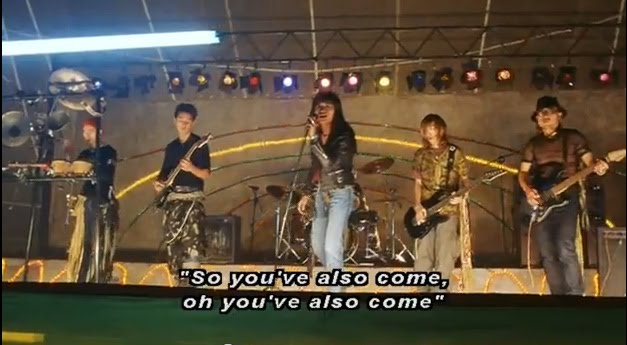
The band on stage is called Moonwatchers, and things start going wrong when the club manager cuts off the lead singer's mic for some reason. The singer gets angry, stops the band, and starts yelling at the manager. A fight ensues, and it ends with the musicians and a couple of girlfriends grabbing as much of their gear as they can and climbing out the windows as the police arrive.


Michael picks up a pair of dropped drumsticks and follows them, finally catching up with them at the kind of cheap hotpot joint that can be found all over Beijing. Much drinking follows as Michael meets this bunch of social misfits who love to make noise and use nicknames. The lead singer is called
平路 (Road, played by 耿乐 Geng Le), and he takes a liking to Michael, though they all mostly refer to him as "Hong Kong Peasant" and make fun of his terrible Mandarin. Road's girlfriend is 杨颖 (Yang Ying, played by 舒淇 Shu Qi, who I think is one of the most beautiful actresses from China, Taiwan, or anywhere else).

The rockers teach Michael how to drink 二锅头 (erguotou, a potent alcohol) in a way I haven't seen done: mix it with Sprite and slam the glass on the table to make it fizz, then pour it down your throat as fast as you can. After a few of those, they pass around a couple joints Michael brought and get very happy.


Michael really likes these people, especially Yang Ying (who wouldn't?), and when his father shows up in Beijing, he packs a duffel bag, grabs his bass, and sets off to find them. They live and practice in a squallid, run-down neighborhood somewhere on the outskirts of Beijing. Ying makes a little bit of money working as a dancer in a cabaret of questionable legality.


As far as I can tell, the girls don't actually strip, just tease, which leads to trouble with the rough crowd one evening when Michael happens to stop by to watch. A nasty looking group of men comes up on stage demanding that the girls strip; Ying hits one of them, causing a big gash on the side of his head, and before long the police are carting the whole gang off. The sideshow manager manages to negotiate Ying's fine down to 5000RMB, but she's locked up in a crowded cell full of women for assault.


As we know, Michael has a rebellious streak, and is currently avoiding his father, so when the sideshow and the rock band decide to go "hole-hopping" (hitting the road without permits), he talks them into letting him come along. They all pile into a rickety old bus and head for the provinces, dancers, jugglers, rock band and all.


One of the unusual things about the movie is the occasional soliloquies by the characters, a bit like the candid interview bits we see on "reality" shows.

As the character talks about their dreams or whatever, there is goofy animation behind them illustrating the words.

At various times during their journeys, Ying and Road get into fights, and they usually end with her stomping out of their tent and spending the night under a tree or wherever. Michael tries to comfort her, and discovers that in spite of the friction, she sees Road as her soul-mate.


The band plays in a variety of poor villages to a mixture of baffled workers and dancing kids, though usually their music doesn't go over especially well. Road's lyrics seem to be pretty heady stuff, mixing Buddhist mysticism with social rebellion.


At one show, Road's father steps into the tent, causing him to stop singing and disappear. Michael saves the performers from an unhappy mob by starting to play 月亮代表我的心 (The Moon Represents My Heart), a famous old Chinese pop song. The rest of the band comes in to provide a rock background as Ying sings the familiar words.


Somehow, during the midst of all this, Road rides his motorcycle back to Beijing to meet with some record label people about signing the band. They don't care for his music or his attitude, and tell him that the rebelliousness of their other rock bands is mere marketing; in truth they are good corporate employees who do what management tells them.


While he's gone, Michael takes the opportunity to spend some time with Ying.


But Road's return puts an end to that. And Road is especially surly after his meeting in Beijing, though he doesn't tell anyone what's going on. He just keeps saying, "I signed it. It's all over."

That's as far as I'll go with the plot. Let's just say the story does not get a happy ending. We find out what really happened in the pool hall before Michael got arrested; and what the consequences will be.


Obviously, there's a lot of music in the film, but only some of it is rock. In fact, it's a little jarring sometimes when the soundtrack swells up with a typical orchestral cue; I wish they'd stuck with the rock theme. When the band is playing live, the mix is often very strange, with the vocals unusually prominent and the guitars rather quiet. I suppose this helps to heighten the focus of Road's creativity and thoughts. In addition to the Moonwatchers' music and the soundtrack, I recognized 唐朝 Tang Dynasty's version of "The Internationale" on the soundtrack, and I believe there are other bands represented as well.


While much of the film seems pretty down-to-earth, I wonder about the portrayal of country folk, which might be considered stereotypical: dirty, unsophisticated, crude, and money-hungry. Local officials like policemen are shown as easily bribed and manipulated.


Other examples of stereotypical characters include Michael's father, who is a slimy lizard more concerned about private pleasure and public image, and throwing his money around, than in his son's happiness. (On the other hand, this seems completely realistic.) And then there are the record company guys, who were totally fake in their fashionable clothes and sneering attitude. (Which again seems totally realistic!)

The editing is a little strange, though completely consistent with the rock idiom. Michael often carries around a little camcorder, and his footage is mixed in with the movie's normal film. The inclusion of the eyes-to-the-camera interview bits with animation takes us a bit outside the story, which serves to emphasize the fact that these characters do not entirely live in the same world as the "normal" people around them.

The jail where Ying spends a little time is really nasty, with a big, dirty cement room filled with women wrapped up in blankets on the floor. The women are made to recite the jail rules in unison in the morning.

There's a lot of swearing, and the language in general is very slangy, with lots of thick accents I found difficult to understand, so I had to rely on the subtitles.


All in all, I enjoyed this movie a lot. It's a fascinating picture of a part of Chinese life we don't see much of, in spite of the rash of documentaries you can find about the Beijing rock scene, all of which are more current, whereas this covers a bit older time period.

This body is a bodhi tree
And the mind a mirror bright,
Carefully we wipe them hour by hour
And let no dust ever alight.
So Buddha says:
If I don't go into hell, who will?

There is no bodhi tree
Nor stand of a mirror bright,
Since all is void
Where can the dust alight?
So I say:
So you say:
So he says:
So Buddha says:
If I don't go into hell, who will?
Wikipedia entry
IMDB entry

It is available from Netflix.