Showing posts with label 中国电影. Show all posts

2011/02/21

The Dianying Diaries, part 5

Part of a series dealing with Chinese cinema. 电影 (diànyǐng) is the Chinese word for movie, the two characters literally meaning “electric” and “shadow.”

图雅的婚事 (Tuya's Marriage)


This
2006 Chinese production is set in Inner Mongolia. It was directed by 王全安 (Wang Quan'an) and stars 余男 (Yu Nan). It provides and interesting mix of drama and humor that feels very true-to-life.


Yu Nan is actually from Dalian, not Inner Mongolia, but to me at least she seems completely convincing riding a horse or camel. All of the dialogue in in Mandarin, though there is some Mongolian singing.


She plays a poor woman with a herd of sheep, a camel, a horse, two children, and a disabled husband named Batoer.


They live in a compound of buildings with no running water; they have a little electricity from a windmill on the roof. They have a neighbor named Shenge who provides a lot of comic relief.


We first meet him lying in the road. He got drunk and wrecked his motorcycle, and luckily he's not seriously injured. He was drinking because his wife left him for another man, something which apparently happens quite often.

Along with their other problems, these people are faced with a constant shortage of water. Batoer's injury was sustained while he was trying to dig a well near the house. Without the well, Tuya has to travel to a spring 15km away once or twice a day...


...in addition to tending the sheep, cooking the meals, and acquiring supplies. Shenge helps out sometimes.


When Tuya hurts her back, it becomes apparent that their lives can't continue as they have. Batoer's sister offers to take care of her brother.


So a plan develops: Tuya and Batoer will get divorced, and Tuya will only marry a man who promises to allow Batoer to live with them and be cared for.


I'm not sure whether it's because of Tuya's reputation as a hard worker, or just that there is a shortage of women in the area, but as soon as word of the divorce gets out, suitors start arriving at their house.


After a couple of less than appealing candidates, a man named Baolier shows up in a Mercedes. He went to middle school with Tuya and always liked her. Since leaving the area, he's become a rich man in the oil business.


The whole family gets into the car and Baolier drives to a nursing home in the city. The plan is that Batoer can live there, and Tuya and the kids will move into Baolier's mansion in another city.


It's a long drive to the city where Baolier lives, so they stop at a hotel, and we get to see Tuya dressed in more contemporary clothing.


But, like so much in Tuya's life, things start to go wrong. There is eventually a wedding, but I won't tell you who she decides to marry.


One of the things I really loved about the movie was the music. It was all very Mongolian sounding, with prominent use of the morin khuur (horsehead fiddle) and traditional singing (though not throat singing).


The vast open space of the Mongolian plane provides stark settings of great loneliness. Everything is far away, and there are no easy means of communication.


Life is very hard in this place, and the strange decisions they make (like the divorce and finding a new husband) are the only way the people can get by. They're doing the best they can in the circumstances.


I believe many of the actors in this film were not professionals, though Yu Nan is well known and has been in many other movies, including a couple of non-Chinese movies (Diamond Dogs and Speed Racer). She was wonderful in this part, which is obviously far from her own personal experience. And in this role, she certainly didn't look anything like she does on a red carpet:

IMDB entry
It is available from Netflix.

2011/01/31

The Dianying Diaries, part 4

Part of a series dealing with Chinese cinema. 电影 (diànyǐng) is the Chinese word for movie, the two characters literally meaning “electric” and “shadow.”

北京乐与路 (Beijing Rocks)


This
2001 movie was a Hong Kong production filmed in Beijing and other parts of Mainland China. It was directed by Mabel Cheung (张婉婷), who is one of Hong Kong's most prominent directors. The story concerns a struggling singer-songwriter named Michael Wu (played by 吴彦祖 Daniel Wu) from Hong Kong who goes to Beijing to find inspiration and learn Mandarin, which is increasingly necessary in the Asian music market.

Back in Hong Kong, Michael's father is a wealthy businessman who is paying for his son's expenses during his creative dry spell. The senior Mr Wu owns a large beautiful courtyard home in an old hutong neighborhood, where Michael, along with his father's mistress, stays in Beijing. In addition to his songwriting, Michael plays in a rock band called the Mexican Jumping Beans, though he says playing rock in HK is a money-losing proposition. So in addition to brushing up on his Mandarin, Michael hopes to dip into Beijing's rock scene.


The other important part of the back story is that Michael is in trouble with the law. There are vague references to some kind of altercation in a Beijing pool hall and the fact that Michael's father has bailed him out of jail and is trying to pull strings on his son's behalf. So it's probably not a smart idea for him to be hanging out in a gritty rock club on the night the plot gets rolling.


Beans are frying in a beanstalk fire
Out from the pan, the beans sadly cry:
"We sprang from the same root, brother
Why do you give me such a hard time?"

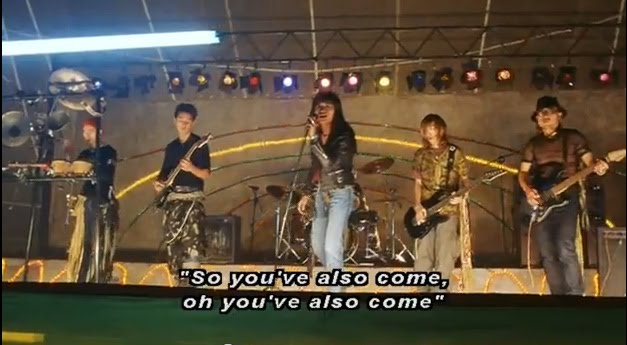
The band on stage is called Moonwatchers, and things start going wrong when the club manager cuts off the lead singer's mic for some reason. The singer gets angry, stops the band, and starts yelling at the manager. A fight ensues, and it ends with the musicians and a couple of girlfriends grabbing as much of their gear as they can and climbing out the windows as the police arrive.


Michael picks up a pair of dropped drumsticks and follows them, finally catching up with them at the kind of cheap hotpot joint that can be found all over Beijing. Much drinking follows as Michael meets this bunch of social misfits who love to make noise and use nicknames. The lead singer is called
平路 (Road, played by 耿乐 Geng Le), and he takes a liking to Michael, though they all mostly refer to him as "Hong Kong Peasant" and make fun of his terrible Mandarin. Road's girlfriend is 杨颖 (Yang Ying, played by 舒淇 Shu Qi, who I think is one of the most beautiful actresses from China, Taiwan, or anywhere else).

The rockers teach Michael how to drink 二锅头 (erguotou, a potent alcohol) in a way I haven't seen done: mix it with Sprite and slam the glass on the table to make it fizz, then pour it down your throat as fast as you can. After a few of those, they pass around a couple joints Michael brought and get very happy.


Michael really likes these people, especially Yang Ying (who wouldn't?), and when his father shows up in Beijing, he packs a duffel bag, grabs his bass, and sets off to find them. They live and practice in a squallid, run-down neighborhood somewhere on the outskirts of Beijing. Ying makes a little bit of money working as a dancer in a cabaret of questionable legality.


As far as I can tell, the girls don't actually strip, just tease, which leads to trouble with the rough crowd one evening when Michael happens to stop by to watch. A nasty looking group of men comes up on stage demanding that the girls strip; Ying hits one of them, causing a big gash on the side of his head, and before long the police are carting the whole gang off. The sideshow manager manages to negotiate Ying's fine down to 5000RMB, but she's locked up in a crowded cell full of women for assault.


As we know, Michael has a rebellious streak, and is currently avoiding his father, so when the sideshow and the rock band decide to go "hole-hopping" (hitting the road without permits), he talks them into letting him come along. They all pile into a rickety old bus and head for the provinces, dancers, jugglers, rock band and all.


One of the unusual things about the movie is the occasional soliloquies by the characters, a bit like the candid interview bits we see on "reality" shows.

As the character talks about their dreams or whatever, there is goofy animation behind them illustrating the words.

At various times during their journeys, Ying and Road get into fights, and they usually end with her stomping out of their tent and spending the night under a tree or wherever. Michael tries to comfort her, and discovers that in spite of the friction, she sees Road as her soul-mate.


The band plays in a variety of poor villages to a mixture of baffled workers and dancing kids, though usually their music doesn't go over especially well. Road's lyrics seem to be pretty heady stuff, mixing Buddhist mysticism with social rebellion.


At one show, Road's father steps into the tent, causing him to stop singing and disappear. Michael saves the performers from an unhappy mob by starting to play 月亮代表我的心 (The Moon Represents My Heart), a famous old Chinese pop song. The rest of the band comes in to provide a rock background as Ying sings the familiar words.


Somehow, during the midst of all this, Road rides his motorcycle back to Beijing to meet with some record label people about signing the band. They don't care for his music or his attitude, and tell him that the rebelliousness of their other rock bands is mere marketing; in truth they are good corporate employees who do what management tells them.


While he's gone, Michael takes the opportunity to spend some time with Ying.


But Road's return puts an end to that. And Road is especially surly after his meeting in Beijing, though he doesn't tell anyone what's going on. He just keeps saying, "I signed it. It's all over."

That's as far as I'll go with the plot. Let's just say the story does not get a happy ending. We find out what really happened in the pool hall before Michael got arrested; and what the consequences will be.


Obviously, there's a lot of music in the film, but only some of it is rock. In fact, it's a little jarring sometimes when the soundtrack swells up with a typical orchestral cue; I wish they'd stuck with the rock theme. When the band is playing live, the mix is often very strange, with the vocals unusually prominent and the guitars rather quiet. I suppose this helps to heighten the focus of Road's creativity and thoughts. In addition to the Moonwatchers' music and the soundtrack, I recognized 唐朝 Tang Dynasty's version of "The Internationale" on the soundtrack, and I believe there are other bands represented as well.


While much of the film seems pretty down-to-earth, I wonder about the portrayal of country folk, which might be considered stereotypical: dirty, unsophisticated, crude, and money-hungry. Local officials like policemen are shown as easily bribed and manipulated.


Other examples of stereotypical characters include Michael's father, who is a slimy lizard more concerned about private pleasure and public image, and throwing his money around, than in his son's happiness. (On the other hand, this seems completely realistic.) And then there are the record company guys, who were totally fake in their fashionable clothes and sneering attitude. (Which again seems totally realistic!)

The editing is a little strange, though completely consistent with the rock idiom. Michael often carries around a little camcorder, and his footage is mixed in with the movie's normal film. The inclusion of the eyes-to-the-camera interview bits with animation takes us a bit outside the story, which serves to emphasize the fact that these characters do not entirely live in the same world as the "normal" people around them.

The jail where Ying spends a little time is really nasty, with a big, dirty cement room filled with women wrapped up in blankets on the floor. The women are made to recite the jail rules in unison in the morning.

There's a lot of swearing, and the language in general is very slangy, with lots of thick accents I found difficult to understand, so I had to rely on the subtitles.


All in all, I enjoyed this movie a lot. It's a fascinating picture of a part of Chinese life we don't see much of, in spite of the rash of documentaries you can find about the Beijing rock scene, all of which are more current, whereas this covers a bit older time period.

This body is a bodhi tree
And the mind a mirror bright,
Carefully we wipe them hour by hour
And let no dust ever alight.
So Buddha says:
If I don't go into hell, who will?

There is no bodhi tree
Nor stand of a mirror bright,
Since all is void
Where can the dust alight?
So I say:
So you say:
So he says:
So Buddha says:
If I don't go into hell, who will?
Wikipedia entry
IMDB entry

It is available from Netflix.

2010/02/27

The Dianying Diaries, part 3

Part of a series dealing with Chinese cinema. 电影 (diànyǐng) is the Chinese word for movie, the two characters literally meaning “electric” and “shadow.”

颐和园 (yíhéyuán, Summer Palace)

Once again I’m visiting a Chinese film not widely known in China. Multiple theories exist as to why it’s been effectively banned (I believe it’s just been refused distribution, but the filmmakers were officially chastised, receiving five-year work bans), and I’ll avoid speculation. It was screened at Cannes in 2006 without the approval of Chinese authorities, a definite no-no, but there are several other “problems” with it, as you’ll see.

This was the fourth feature film for director Lou Ye (娄烨), and he had encountered problems with the authorities on two of his earlier works (Weekend Lover 周末情人 and Suzhou River 苏州河 ).
Summer Palace is the story of a young woman named Yu Hong (余红), played by Hao Lei (郝蕾). She comes from a provincial city to a university in Beijing in the fall of 1988, leaving behind a boyfriend and her father. After an initial period of remaining solitary (even in her four-person dorm room), she meets Li Ti (李缇, played by Hu Lingling 胡伶伶), whose boyfriend is studying in Berlin and whose roommate is often not around. The two girls develop a strong bond, and after Yu Hong meets Zhou Wei (周伟 ), played by Guo Xiaodong (郭晓东), and starts dating him, Li Ti volunteers her room for them to share, and it becomes the scene of relatively explicit sex scenes.
This inclusion of full frontal nudity (both male and female) and the appearance of sexual activity is quite unusual in a film from Mainland China, but it is integral to the plot. Yu Hong provides narration from time to time, explaining her feelings, which are confused and a little odd at times. Several of the couple’s dates take them to the Summer Palace, where we see them sitting on a bench and looking at the lake.
Yu Hong makes it clear that she believes Zhou Wei is the love of her life, but nevertheless comes to the conclusion that she must break up with him – I won’t go into her twisted logic for this decision. She does so by convincing him that she has slept with her psychology tutor, which she may or may not have actually done. After the breakup, she drifts through some other boyfriends, but nothing serious.

In the meantime, the spring of 1989 has arrived, and with it massive student protests. None of the main characters are involved directly, but the chaos of marches, canceled classes, and the uncertainty of the government’s response to the situation forms a poignant backdrop to the emotional turmoil within Yu Hong.
Of course, the filmmakers weren’t able to re-enact these huge public scenes, so actual documentary footage from the time is used, and given the somewhat grainy appearance of the normal film, the combination is seamless.
At some point during all the confusion, Li Ti and Zhou Wei start having an affair.
Shortly after these events, Yu Hong decides to drop out of school and return to her home town. The friends scatter, with both Li Ti and Zhou Wei relocating to Berlin. We get a series of brief scenes during which Yu Hong has several affairs, including a married man. From her narration, it is clear that whenever she feels lonely (still pining for Zhou Wei), she finds a man to have sex with, and during the act is the only time she feels content. Various world events play out on the sidelines, including the handover of Hong Kong. We also get some scenes set in Berlin, where we see that Zhou Wei and Li Ti occasionally have sex but don’t really feel anything for each other.
The static situation ends when Li Ti suddenly jumps from the roof of a building, prompting Zhou Wei to return to China. Once there, he tracks down Yu Hong and arranges to meet her.

But when they finally meet, they hardly speak to each other, just drive around and walk on a chilly beach. In the end, they part without goodbyes.
This story of am emotionally unstable woman has some immensely appealing aspects. The first part of the film, up to when Yu Yong leaves Beijing, is really quite good. The scenes set during the Tienanmen student protests were quite moving given the knowledge of what was going on offscreen. But from there on, it just becomes fragmentary and disjointed. The inclusion of the scenes in Berlin further confuses the focus. In a film so centered on Yu Hong, even to the point of including her inner thoughts, it is jarring to suddenly be watching scenes that are completely outside her experience. The scattered second half of the film actually becomes a bit tedious as we wonder how many times this girl is going to screw up her life and those of others.
The portrait of student life in the late 80s was fascinating, showing China’s early encounters with Western music and more individual freedom. But just as those trends came to a crashing halt after June 4, 1989, so did the sense of enjoyment in the movie. At first I really enjoyed Yu Hong’s rebellious nature and sense of fun, but as the story proceeded her problems became more and more apparent, and eventually ended up being kind of tedious. Maybe this was intended as a subtle commentary on the changes in Chinese society, but if so, it’s too subtle to be sure of. And that doesn’t alter the fact that it became so uninteresting towards the end.
All in all, I would say that this is one half of a really good film edited together with one half of a not very good film. As you can tell from my description, there are several aspects of the film which might cause displeasure to the Chinese authorities, including the nudity, the inclusion of film of the student protests, and the lack of an uplifting ending. My problems with the film don’t involve any of these issues, but the lack of coherence and focus. The running time of 140 minutes would not seem excessive if the story justified it. As it is, I can’t really recommend it, though I commend Lou Ye for having the courage to make it.

Wikipedia entry
IMDB entry

It is available from Netflix.

2010/02/05

The Dianying Diaries, part 2

Part of a series dealing with Chinese cinema. 电影 (diànyǐng) is the Chinese word for movie, the two characters literally meaning “electric” and “shadow.”

小城之春 (xiǎochéng zhī chūn) – Springtime in a Small Town (2002)

As I mentioned last time around, the 1948 Chinese classic film with this title was remade in 2002. Though the official English titles are different, in Chinese they are identical. This time around, the director was Tian Zhuangzhuang (田壮壮 ) of the so-called Fifth Generation of Chinese filmmakers, along with Zhang Yimou (张艺谋) and Chen Kaige (陈凯歌 ). Tian’s career has been very erratic, with a smaller number of films to his credits than others of his generation. This is due in great part to the aftermath of his 1993 film 蓝风筝 (The Blue Kite), which was banned in his homeland and earned him a forced hiatus for a few years. Even after his blacklisting was over, he did not make another film until this one nearly ten years later.
On the surface, this film is a marked departure from Tian’s tendency to push the boundaries of what his government would accept – it’s a simple story of a love triangle with no significant political or historical content. The plot remains unchanged from the original, so you can read my previous entry to see what it’s about. There is perhaps a slight bit of subversion in the choice to remake a neglected classic, first since that film was somewhat out of favor (though not banned). And by retreating into the past, to a movie that was made before the Revolution, maybe he was making a statement about how the authorities’ restrictions served to render Chinese artists impotent. But we should not read too much into these possibilities.

If I had seen this film on its own, and not shortly after watching the original, I might very well have felt differently about it. To be honest, this modern film suffers from the comparison in most respects. Although it garnered positive reviews both in China and abroad, I find it pales next to Fei Mu’s achievement.

To illustrate why I feel this way, let me go through some of the things I noted about the original, comparing the differences.
(The original Yuwen meets the new Yuwen)
First of all Yuwen’s narration is gone. In the DVD extras, Tian explains that her narration reduced the other characters’ importance, and he wanted to tell the story in a more balanced way, giving equal weight to Liyan and Zhicheng. I would call this change neutral.

Second, the character of Little Sister is significantly altered. Far from being the perceptive young woman she was in the original, she is giggly and immature. I’ve considered that maybe it’s just the choice of the young actress for the part, but it’s more than that. Frankly, the character of Little Sister in the original was a real joy; even when she wasn’t speaking you could see from her attitude that she understood what was going on maybe better than anyone else in the story. Her reduction to a shallow teenager is quite a loss for the film.
Third, the dialog is much more naturalistic, lacking the stagy quality I noted in the original. I’d have to call this one in Tian’s favor. While the acting style of the original didn’t really bother me, by comparison this seems more true-to-life. In addition, there’s a lot more talking in this version – some scenes that were nearly silent before now have dialog.

Fourth, Yuwen mostly lacks the forthright flirtatious manner she sometimes exhibited in the original. I found it decidedly odd that a 21st Century film would actually be less daring than its 1948 source. Yuwen is on the whole less energetic, independent and engaging in this go-round.

(I couldn't find this part with subtitles. The rowboat scene is about five minutes in.)
Fifth, while there are still scenes with singing, it is no longer Chinese folk songs that are sung. In the wonderful rowing scene of the original, they sing an ode to springtime, that, while it’s sung in Chinese, is set to the tune of “The Blue Danube.” And when Zhicheng gets drunk at Little Sister’s birthday party, he sings a piece from an Italian opera.

And finally, this film is in color. The cinematography is really lovely, but does lack the sense of desolation that the black and white gave us. As before, the lighting is often dim, though the candlelight now provides a warm glow rather than feeble flickering.

Another difference that was quite jarring was this: in the original, we never so much as saw another human being aside from the five principles. Now, for no reason I can make out, there is a single scene that breaks out of that confinement. Zhicheng goes to Little Sister’s school and teaches her classmates how to dance a waltz (again, note the favoring of a foreign influence over Chinese tradition).

To some extent, the rowing scene sums up the changes Tian made to Fei’s movie. The camera angle is much wider, giving us a detached, less engaged feeling; the characters do not exchange any meaningful glances, giving little hint what they’re feeling; and a Chinese folk song is replaced with a bastardized version of a European classical tune.

So while I would not say Tian’s film is a classic of Chinese cinema, it is far from a bad film, and shows lots of craft in the making. Tian obviously knows what he is doing, and what I see as shortcomings here are for the most part deliberate choices, not failures in movie-making skill. I wouldn’t want to discourage anyone from watching this picture, but would definitely urge everyone to seek out the original.

Wikipedia entry
IMDB entry
Netflix entry

2010/02/01

The Dianying Diaries, part 1

Part of a series dealing with Chinese cinema. 电影 (diànyǐng) is the Chinese word for movie, the two characters literally meaning “electric” and “shadow.”

小城之春 (xiǎochéng zhī chūn) – Spring in a Small Town (1948)


This film was made by director Fei Mu (费穆 ) just before the Revolution, so you can’t expect any propagandistic content. As you might recall, Japan occupied much of China starting in 1937 (the Second Sino-Japanese War), and weren’t finally expelled until 1945. This story is set in about 1946 in the aftermath of the war, and though it gets only fleeting mention, it is silently present in the ruined setting.
In a small town that is never named (it was filmed in Wuzhen (乌镇) in Zhejiang (浙江) province) but is somewhere not too far from Shanghai , the Dai family has its home. Their large compound, with multiple courtyards and many rooms in adjoining buildings, was heavily damaged by Japanese mortar fire, and in any case only four people now live there.
Dai Liyan (戴礼言, played by 石羽 Shi Yu), though only about 30, is the family patriarch. He has been in ill health for six years – it is suspected that his respiratory problem may be tuberculosis.
The second resident is his wife of eight years, Zhou Yuwen (周玉纹, played by 韦伟 Wei Wei). (Remember, in Chinese culture, women do not take their husband’s family name.) She is pretty but withdrawn, having lived in separate rooms from her husband since early in his illness. She takes care of him dutifully, but there is no affection apparent.
Liyan’s younger sister Dai Xiu (戴秀, played by 张鸿眉 Zhang Hongmei) is the third resident. She is 15, a very bright and perceptive girl, usually referred to as Little Sister (妹妹).
Finally there is Lao Huang (老黄 literally “Old Huang” – a typical way to refer to an older man, and not at all disrespectful, played by 崔超明 Cui Chaoming), the family’s loyal servant, who has been there longer than any of the others.
Over the years they’ve developed a routine. Every morning Yuwen rises and takes a basket into town to get groceries and her husband’s medicine and walks along the old city wall on the way home; Liyan gets up and sits in the garden, sometimes attempting repairs or tending plants; Little Sister gets up and walks to school, sometimes coming home for lunch, sometimes not until after school; Lao Huang takes care of things around the house. Presumably they have dinner together, though we don’t see that directly.
Shortly after the movie starts, their routine is interrupted by the arrival of Zhang Zhichen (章志忱, played by 李纬 Li Wei), a childhood friend of Liyan. Liyan hasn’t seen him since Zhichen left town to attend medical school in Shanghai. Through circumstances that aren’t explained, Liyan is unaware that Zhichen was Yuwen’s boyfriend when she was 16, before she met Liyan, and Zhichen is unaware that his former girlfriend married his old friend. These five characters are the only people seen in the entire film.
Zhichen’s arrival (he stays for several weeks) serves to highlight the emptiness of Yuwen’s marriage, and though this side of the love triangle is never consummated (this shouldn’t be a spoiler when you consider where and when it was made), tensions rise, and we wonder if Yuwen will leave her husband to be with her true love, or perhaps even do something more serious.

That’s enough of the plot. There are a few things to note about how the story is told.
Yuwen provides voice-over narration, mostly giving us background, sometimes revealing her thoughts, and occasionally providing information she really shouldn’t know according to the events seen on screen. Sometimes this is a little jarring, especially when the voice-over is interspersed with conversation.
Second is that Little Sister is quick to pick up on what’s going on. She can tell there is something between Yuwen and Zhichen, feels sorry for Yuwen’s unhappy situation, and is not blindly supportive of her brother; she’s slightly flirtatious toward Zhicheng.
Third, the dialog is a little stiff and stagy, rather like a play translated to the screen, though to my knowledge the screenplay was based on a short story, and there never was a play. I attribute this mainly to the era in which it was made. I understood enough of the dialog to pick this up, and I know others who don’t understand Chinese at all who have come to the same conclusion.
Fourth, in her scenes with Zhicheng, Yuwen is often quite playful, even a little flirtatious. There’s one scene where she circles her old boyfriend playing with a scarf, covering the lower part of her face like a veil while her eyes sparkle mischievously.

Fifth, there are several scenes with singing, usually Little Sister singing a Chinese folk song, but very little in the way of incidental music. There is a really interesting scene where the three principles take a boat out onto the river with Little Sister and they sing 在那遥远的地方 (zài nà yáoyuǎn de dìfang "In That Distant Place") together.
And finally, it is in black and white, with the ruined house seeming all the more desolate for the lack of color. Many scenes are lit by the dim overhead lightbulbs that make up the majority of the old house’s lighting, and at the times when the electricity goes out, there are only candles and lamps.

I mention some of these things for future comparison with the 2002 remaking of this story, which I’ll talk about in a forthcoming post.

The lack of political content led to the disfavor of the Communist government, which had the policy that art should further Party ideals. Since it didn’t contain any uplifting messages of the people overcoming oppression, it had no place in the country’s cultural mixture, seen as “Rightist” maybe more by default than by anything actually in it. So while it was never outright banned, it was basically ignored for decades, in mainland China at least. It also didn’t help that director Fei Mu fled to Hong Kong after the Revolution. Luckily copies have survived, though the DVD transfer I watched had some flaws, places where the picture or sound had problems. Others of Fei Mu’s early work have not been so lucky.
As I mentioned, the acting is maybe a little stiff by modern standards, and reminded me somewhat of American movies of the thirties. But I would not say that this film was in any way behind the the times for its era. The camera work, framing, and lighting are all quite good.

All in all, it is a fine film, and worthy of a place among the world’s classics of cinema. In 2005, the Hong Kong Film Critics Association voted it the greatest Chinese film of all time, topping a list of 100 movies weighted heavily towards the HK industry.

Wikipedia entry
IMDb entry
Netflix entry