Showing posts with label temple. Show all posts

2011/03/01

A temple in my back yard

This post covers things I saw on 5 October, 2010.

Several times each day, I would walk between my hotel and Line 4's Xisi Station. Eventually I noticed that over the construction fence there were some golden-tiled roofs, which usually indicate something interesting.


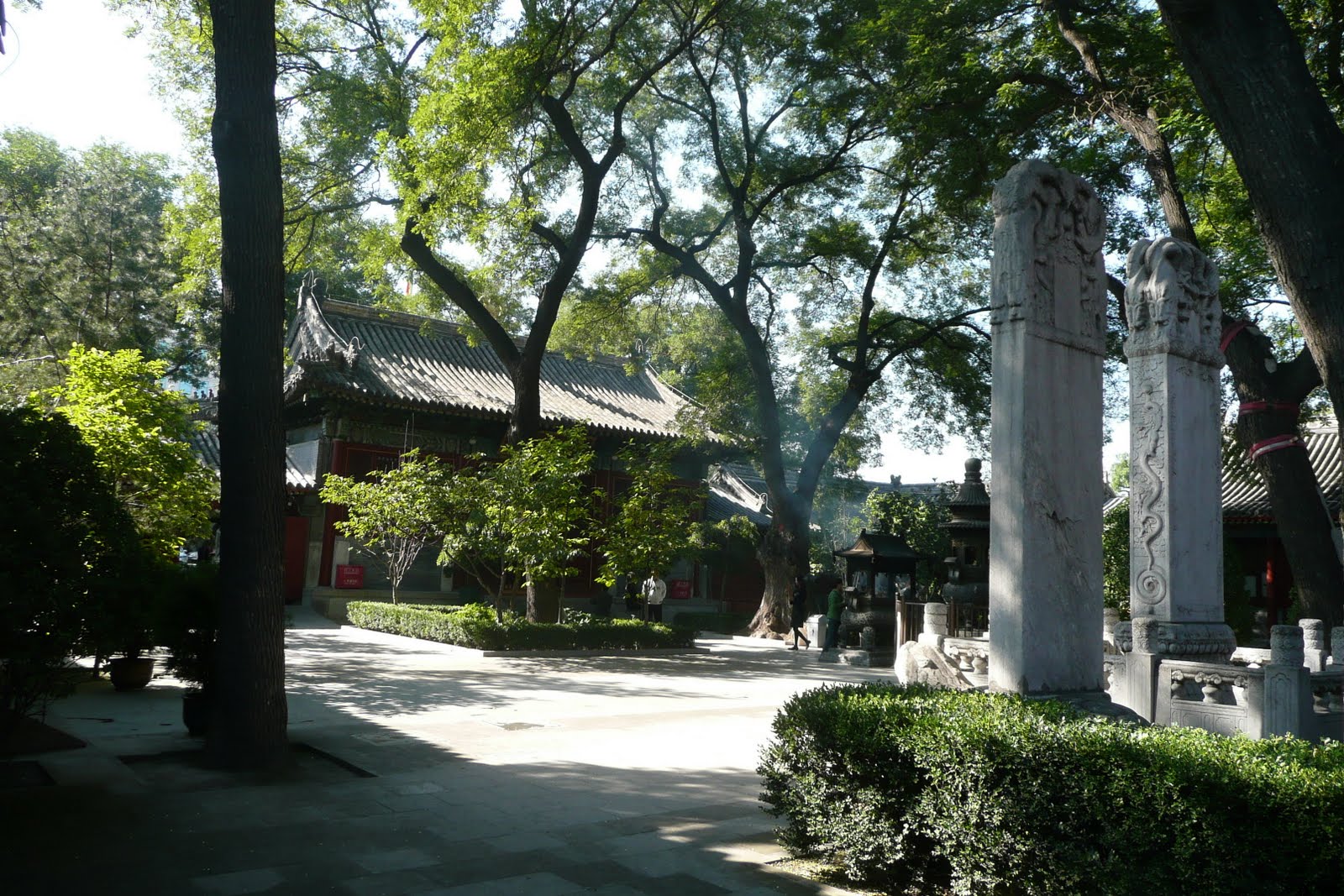
So I walked around the corner and found the entrance to 广济寺 (Guangjisi), which is a Buddhist monastery and temple. Entrance is free.


As with the other temples I've visited in Beijing, it is somehow insulated from the hustle and noise of the busy street just outside its walls, creating a little island of peace and tranquility.


One difference between this and most of the other temples in Beijing is that this is an active religious facility, not just a historical relic. It is the home of 中国佛教协会 (the Buddhist Association of China).


It's not a very big temple compared to something like the (The Temple of Heaven), but it's very nice in a humble way. One odd thing I saw there was a Buddhist nun wearing her robes wandering around in the parking lot, yelling loudly to no one in particular. I couldn't understand a lot of what she said, but she seemed to be complaining about things "they" were doing. If I saw a woman doing this in Seattle, I would assume a mental illness and hope she's getting treatment. On my way out, I saw a couple of civilians (not wearing robes at least) talking with her, apparently trying to calm her down.


It seems to be traditional that temples have cats, and my personal tradition is to take pictures of them.

2009/08/07

Plants and Birds and Rocks and Things

I had previously visited two of the major attractions on the western outskirts of Beijing: Xiangshan and Badachu. Recently (18 July) I added another, 北京植物园 (Zhiwuyuan, the Beijing Botanical Garden) which contains 卧佛寺 (Wofosi, the Temple of the Sleeping Buddha). Once again, I used a city bus to get there.
The bus passes by some interesting looking temples that I would love to visit someday.
The place is full of lovely landscaping, including ponds and bridges.
There is also a section of the huge park devoted to 曹雪芹 (Cao Yueqin), who wrote the classic 红楼梦 (Hong Lou Meng, Dream of the Red Chamber), which I have written about before.
The location in the hills is quite lovely, and a wide variety of different kinds of trees grace the grounds.
As I mentioned, there is an old temple inside the Garden grounds.
Inside the Glazed Arch is a little pond with koi and turtles.
The Sleeping Buddha itself is in a building where you are not allowed to take pictures.
You can see a bit of the bronze Buddha inside. It’s 5.3 meters (17' 4") long and weighs about 54 tons. The words over the door (明恒月性) I believe are supposed to be read right to left in the ancient manner, and have something to do with the quality of the moon being constant brightness. Either that or some kind of wish for the Ming Dynasty to last forever, since the name of the dynasty, 明 Ming, means bright.

Up the hill behind the temple is a little stream running down a shaded valley.
As you can see, this is a popular area for families to enjoy a little bit of nature.
Further up the valley is a grove dedicated to the metasequoia, also known as dawn redwood. This tree is common in the fossil record from millions of years ago, and was believed extinct until a small stand was discovered in Sichuan in 1944. Since then they have been planted all around the world, but it is still considered a critically endangered species. These trees were planted in 1975.

And for the bird lovers out there...
...I present a blurry telephoto shot of a fairly large bird I saw eating a fruit in a tree near the trail.

Back down in the valley, I found some nifty water plants.
One of the main attractions at the Garden is the Conservatory.
This is where they keep tropical and desert plants. As it turns out, the day I went there was so hot that it was actually cooler in some parts of the greenhouse than it was outside.
And they couldn’t resist adding some water features.
On the upper level is the desert area, with lots of cacti and succulents from various parts of the world. And a little Egyptian statue because just plants are not enough.

On the subject of not being able to resist:
No jungle is complete without dinosaurs.
Or terracotta warriors.

Like I said, the Garden is really huge, and there are parts of it that are currently not used much.
I rather like this picture of a disused path off to an unpopular area.

I’ll finish off with a collection of invertebrates I saw in the Garden.
Dragonfly (蜻蜓 qingting), mantis (螳蜋 tanglang), some kind of beetle (甲虫 jiachong), and millipede (千足虫 qianzuchong).

So that is the Botanical Garden. I must say it is much, much better than the Zoological Garden, and well worth the trip out of the city. It was very hot the day I went, but there are vendors with beverages and ice cream all over the place.

2009/07/11

Short visit to the land of the departed

One of the places listed in most guide books for the Beijing area is the Ming Tombs. In the Eyewitness Guide it says “best visited by taxi” – and maybe I should have believed them. But that would be really expensive (it’s quite a distance from town), and there’s the hassle of arguing with the driver about the price for basically a whole day off the meter, so I decided to go the “local” way and use public transportation. After all, there are bus routes that go there. But the simple truth is that there really isn’t a “local” way to visit this place – locals just don’t go there.
As you can see, there are no other passengers on the bus, just the driver and the girl who takes the money, since this bus isn’t equipped with a card reader. The ride all the way to the Ming Tombs cost Ұ2, less than US$1. The catch is that it took well over an hour, and in this picture you can see one of the reasons why. We’re sitting still with the engine off on a narrow road that has a fence along one side and cars parked haphazard along the other, making it impossible for traffic to go in both directions at the same time, even though it is a two lane road. This is apparently a popular picnic spot (there’s a lake at the bottom of the hill on the right side) and there is no proper parking. So the bus and everyone else has to wait for a break in the oncoming traffic in order to grab the available lane. I didn’t see anyone directing the cars, it was just a free-for-all. Previous to this, we’d sat still for a long time at a construction site where they were working on a bridge.
As I said, locals generally don’t go here, but the place was far from empty. It’s a standard stop on many tours that go to the Great Wall at Badaling, since it’s on the way. The bus will swing by here in the morning, let the tourists have an hour or two to look around, and then continue on to the Wall.
As it turns out, 2009 marks the 600th anniversary of the building of the main tomb, which is called 长陵 (Changling) and houses the remains of the Ming Emperor Zhu Di (also called Yongle), who died in 1424. You might notice that 1424 to 2009 does not make 600 years. The tomb was built in 1409 when the empress died, and when the emperor himself died, he was brought here as well.
The main mausoleum is a very large building, the largest mausoleum in China.
Inside, there is a museum of relics from Zhu Di’s time, and this statue of him.
This is an incredibly elaborate crown made mostly of tiny gold wires woven into shape.
And these are some “household” objects carved of jade.
After passing out the back of the mausoleum, you continue on to another building. If you look closely through the arched opening, you can see a group of people stepping over the threshold of a gateway. Tradition has it that when you approach the grave area, you walk around the side of this gate, and when you come back from the grave area, you step over the threshold while loudly saying “I’m back!” so the spirits will know that you belong in the land of the living.
The last building contains a large stele. Zhu Di is buried somewhere in the tree-covered mound you can see out the back. The tomb has never been excavated, and is believed to be untouched since the burial. The tomb of one of the later Ming emperors was excavated back in the 1950s, but the projct was such a disaster that China has shied away from this kind of archeology since. That was in the days when the country was closed to the outside world, and the were quite a bit behind in scientific excavation techniques, and even more behind when it came to preserving the artifacts uncovered. Thousands of precious silks and scrolls were lost because China at the time did not have the means to save them.

The Chinese name for the Ming Tombs is 明十三陵 (Ming Shisan Ling), which means Thirteen Ming Tombs. There are twelve other mausoleums scattered around the area, but the distances between them are too great to be practical on foot, so I wasn’t able to see any of the others. I also missed the famous Spirit Way with its line of statues. I’m told it should have been possible to see it from the bus if you knew exactly where to look, which I didn’t.

As it was, the round trip transportation time was more than three times what it took to actually see what was there. The museum was nice, and would certainly be worth visiting if it wasn’t so hard to get to.

2009/05/31

Teach your children

As I continue my journey down the list of Beijing sights, I find myself at Kong Miao (孔庙), the Confucius Temple. It’s actually pretty close to my old office in the Gehua building, just a couple blocks from the Lama Temple (which I’ve been to twice but apparently never written about), but I never got around to it until last week.

I went with a Chinese friend who was very surprised that an American knew anything about Kongzi (孔子 551 BC – 479 BC ) at all. But I told her that while we don’t really study his teachings, we know his name and the cliché “Confucius says...” And since I’m interested in China, I know that Kongzi was a very practical philosopher who concerned himself almost entirely with down-to-earth things like how to get along in society, ethics, and how a country should be governed, not with supernatural things like gods and demons.
Anyway, Kong Miao is a relatively small complex originally built in 1306. It has been renovated recently, and has many exhibits about the man’s life, teachings and legacy, though they are not anything like the impressive museum at Jinsha in Chengdu.
Each of these structure contains a carved stele commemorating some event, like an emperor expanding the temple or rebuilding part of it.

The temple grounds are home to many old trees.
I think they are more than 300 years old.
And the vines hanging from some of them work as swings.

There are many exhibits covering the Master’s life.
This one illustrates his travels from kingdom to kingdom trying to spread his ideas.

Music is very important in Kongzi’s philosophy.
The smaller instruments in the front are guqin (古琴), the larger ones are a fancy version of either se (瑟) or guzheng (古箏) (without the bridges that tune the strings), and the tuned bells hanging behind are called bianzhong (編鐘) – I think, the ancient names of the instruments are sometimes not the same as very similar looking modern ones. There is also another instrument arranged like the bells, only with tuned slabs of stone that are struck with mallets.

That covers the photographic highlights of Kong Miao. Most of the exhibits didn’t lend themselves to picture taking. Although Kongzi’s teachings fell into disfavor – violent suppression, even – during the Cultural Revolution, there’s been a resurgence lately, with modern Chinese seeking to restore some of the traditional values they find lacking in modern society. And honestly, if you look more at the actual writings rather than some of the religious trappings that were later grafted onto Confucianism, it’s pretty hard to fault the values contained in the Analects. One of the things it is widely known for is respect for authority, both within families and in government, but that is tempered by two additional teachings. First, underlings are obligated to speak up when they feel leaders are going astray, even to the point of justified rebellion in the case of tyranny. And second, authority must be earned, not inherited, so leaders have their positions due to virtue, not just lucky birth or force of arms. It is these caveats that caused the kings he spoke to to reject his teachings. And in later centuries, when his teachings did become orthodoxy, the focus was often more on submission than virtue.

One of Kongzi’s prime teachings is the same as other philosophers around the world have come up with, though it is stated differently:

己所 不欲、勿施於人
jǐ suǒ bù yù, wù shī wū rén
Never impose on others what you would not choose for yourself.

That’s the translation of David Hinton. It should sound familiar to everyone, I think. And stating it as a negative, rather than the positive statement we’re familiar with as the Golden Rule, has the advantage of avoiding some of the problems that more modern thinkers have found with it. To divert into philosophy, the problem with “Do unto others as you would have them do unto you,” is that it leads to silly things like, “I would love for someone to give me some bacon, so I should give my neighbor some bacon,” when the neighbor is a vegetarian. To be fair, Kongzi actually does encourage proactive reciprocity in other places as a means of enhancing the public good.

And the other thing we have to remember is that Kongzi himself never wrote down his teachings. Much as with other ancient religious and philosophical teachers, the writings we have were compiled after his death by his followers, and there’s no way to know what Kongzi himself actually said.

Anyway, back to ancient Beijing.

Next to Kong Miao is Guozijian (国子监), which was the Imperial College, and the same ticket (Ұ20) gets you into both.
In the center of the main yard is this lovely building:
If I understood correctly, it was only used when the Emperor visited the school. He would sit at the elaborate desk inside...
...and lecture the students who stood outside all around. The water was drained from the circular pool around it while one of the bridges was being repaired, but I can see it would be really pretty when it is filled.

There’s another statue of Kongzi.
And a mock-up of what an Imperial classroom looked like.
The professor is at the center desk, and the students would have been at tables on the two sides of him, outside the area of the picture.

The College’s main function was to prepare civil servants for the massive Imperial bureaucracy, which theoretically (by Confucian ideals) was open to students from all social strata, though in practice it catered to the aristocracy. Sons of poor families were needed to support their households and couldn’t afford to spend time on such things as studying.

The whole system started to decline a bit before the end of the last dynasty, and the College fell into disrepair until its recent renovation.

This is another of those Beijing locations I would not recommend unless you’re a Confucius buff or really into history. Or are small in stature and like to swing from trees.

2009/05/13

And all the rest

There are so many things to see in Sichuan that four days can hardly scratch the surface. I've covered pandas and Giant Buddha as well as a bit about food and downtown shopping, so this time I'll write about the rest of the trip, which involves various things around the city of Chengdu.

One of the famous sites in the city is the Wuhou Temple (武侯祠), which is not far from the center of town. This complex is built around the large tomb of Emperor Liu Bei (刘备) of the Shu Kingdom (221-263) and mostly honors his premier, Zhuge Liang (诸葛亮), one of the most famous strategists in Chinese history. “Wuhou” means “premier” (in the sense of the government official, not any of the other meanings of the word) or “chancellor”.

Liu Bei's tomb has not been excavated – it's just a large circular mound with trees growing on it, presumably with a burial chamber somewhere beneath it.
That's the burial mound on the right. There is a circular wall built around it, which I think dates from about 1700, when the original construction was rebuilt by the Kangxi Emperor of the Qing Dynasty.

In the garden area outside the circular wall is a wonderful garden of miniature trees.
We think of bonsai as a Japanese art, but like many things, the Japanese learned it from the Chinese.
There is also a museum devoted to the arts of the Three Kingdoms period.
And here is the statue of Zhuge Liang.
One of the fun things about this complex is the carved animals that decorate the railings.
Each of them is different, and there are a wide variety of animals represented, both real and mythical.

Immediately adjacent to the temple complex is Jinli Street (锦里路).
This street dates to the Qin Dynasty (221BC-206BC), when it was one of the most prominent streets in the city, but there is virtually nothing left from that time period. It was reconstructed in 2004 for a taste of Old China. I'm pretty sure the Qin Dynasty didn't have Starbucks (新巴克).
There are shops and booths selling a large variety of local handicrafts and other goods, plus some imported things from Tibet, India, and so on.
This man is making elaborate shapes out of sugar.

And of course there's an area devoted to food.
This is the latest entry in the “too cute to resist” category:

Another site in Chengdu is the Yongling tomb (永陵), where Wang Jian (王建 847-918) is buried.
Like Liu Bei's tomb, it features a large circular mound. That's what you see with trees on it above the faded red doorway. The path to the opening is guarded by statues of animals and men. Photography is not allowed inside, so here is a link to a bunch of pictures. You can actually go inside this mausoleum, which was raided over the centuries of many treasures but still holds a lot of history. The most interesting thing is that the sarcophagus is decorated with carvings of 24 female musicians and dancers, providing a wonderful glimpse into the music of the era.

Moving even further back in history, there is the Jinsha (金沙 or Golden Sand) site. In 2001, during some new development, workers stumbled upon many old artifacts, and when experts were called in, they found remains of an extensive settlement dating to the Ancient Shu Culture around 1000BCE. Careful excavations were conducted, and thousands of items were found. Archaeological work has stopped now, and the main site has been enclosed in a large building.
It's only about 5k (a couple of miles) from the center of town.
They've built a raised walkway across the site so you can see many things close up, and there are signs indicating where the most famous items were found.
One thing that is really surprising is that thousands of elephant tusks were found, apparently buried in a ritual manner. It seems that elephants were common in this area 3000 years ago. There certainly aren't any around now.

A short walk from the excavation site is the museum.
The circular skylight at the center of the building is designed to resemble one of the most famous items found there, the Immortal Sun Bird Disk.
At the bottom of the central shaft the design is repeated, for a really lovely effect.

Here's another of the famous artifacts.
This is one of the most artistically designed museums I have ever seen. All of the displays are beautiful, undoubtedly modern but also suited to the ancient items presented. The ambient light is very low, making it really difficult to photograph, with dramatic spotlights on the items.
This beautiful gold foil disk presents such an evocative image that it was chosen as the symbol of China's ancient heritage. It is part of logos you see around the entire country.

The Jinsha site also features a cultural center where there are shows with dancing and so on, but it was closed when we were there. Jinsha is related to another famous site called Sanxingdui (三星堆 or Three Stars Mound), which is even older, but is farther from town, so we didn't have time to see it. Next time... Both sites represent a period of China's history that is not very well understood. For example, it is unknown what happened to the people who lived here 3000 years ago.

The last place in Chengdu we visited was the Wenshu Monastery (文殊). It's located not far north of the center of town.
It dates from the Tang Dynasty and is today the home of the province's Buddhist organization.

I particularly like this statue:
Note the monkey underneath the elephant feeding it. And yes, the elephant is carrying the world on its back. The globe is fairly detailed with the Earth's continents, so I'm sure this is not an ancient thing.

There are beautiful gardens behind the temples, and at the back is this amazing building:
There you go, Chengdu highlights in words and pictures.