Showing posts with label Forbidden City. Show all posts

2011/03/01

I circle the Square

This post covers things I saw on 5 October, 2010.

On the first day after the music festival, I figured that with it being the national holiday and all, Tiananmen Square (天安门广场) might be interesting. It was certainly crowded.


That's what I saw after coming out of the Tiananmen West subway station. The empty gap just on the other side of the fence is Chang'an Avenue (长安街), and beyond that is the Square filled with people. It was a warm, sunny day, and there were vendors everywhere hawking ice cream bars and little Chinese flags.

Turning around from that spot, you see this:


I wanted to get a closer picture of the big Mao painting, so I crossed the little bridge that takes you toward the Forbidden City (known to the Chinese as 故宫 - Gugong, or Palace Museum), and found that crowd control didn't allow me to return. I was swept along with the masses.


I've already seen the Forbidden City, and it was really crowded, so I looked for a way out that didn't involve buying a ticket. I found it with the entrance to Zhongshan (中山) Park, which for some reason I had never before visited.


Just inside this entrance (it's the East gate of the park) is the Southwest section of the Forbidden City's moat.


And it seems I wasn't the only one who ducked into the park to get a little break from the crowds outside.
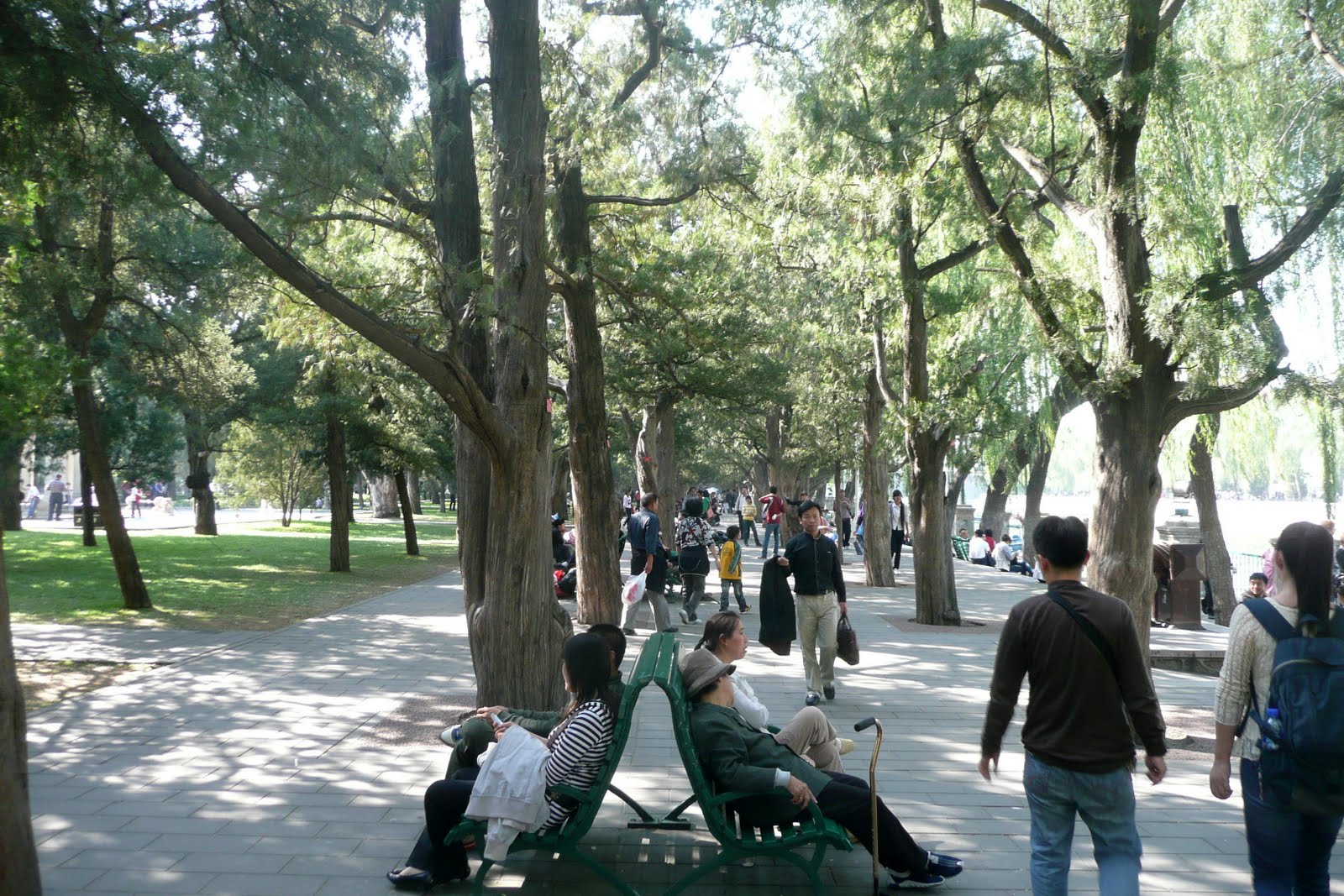

I wandered around the park, my only plan that I wanted to exit to the south, where I could get back to Tiananmen Square and the subway, but I took my time. The park is named after 孙逸仙 (Dr Sun Yat-sen), who is generally known to Mainlanders as Zhongshan, and is regarded as the father of modern China.


Given the history of the founding of the People's Republic of China, their reverence of Zhongshan seems a little odd, what with him being a Nationalist rather than Communist, but he's been branded a "proto-socialist" Forerunner of the Revolution and escapes the negative image of his successor 蒋介石 (Chiang Kai-shek).

As I wandered around, I came across these:


It's a long rack of 特鐘 (teqing) stone gongs. They can be struck with a mallet and produce a ringing tone.

Another common sight in any of China's historical places is parents or grandparents taking pictures of the kids dressed in royal costumes, or at least headwear.

And no Chinese park is complete without some Strange Stones.


I thought this old couple was really adorable. They looked like country folk come to the big city to visit their families and see the festivities.

And of course there's another thing needed to complete an old Imperial park:


Gotta love the theme of the decoration on those things! Looks more like the Fourth of July than Chinese National Day.

I finally worked my way around to the South Gate and took the pedestrian tunnel to Tiananmen Square.


People mountain, people sea, as they say. (It's a Chinese expression meaning a lot of people: 人山人海. My teacher told me there are several stories about how the expression came about.)


Normally the entire square is flat paving, but a big fountain surrounded by flowers has been constructed, and there were quite a few other big floral displays here and there. They've also installed two massive video screens.


They show inspirational scenes of beautiful landscapes, historic places, and (of course) the Olympics. In between the two video screens there's a giant portrait...


...of Sun Yat-sen. In the background is 人民英雄纪念碑 (The Monument to the People's Heroes), and behind that is Mao's Mausoleum.

2008/05/18

Journey to the Centre of the Egg

Of course, not all of Beijing’s landmark buildings are old, or even old style. I’ve shown pictures of the CCTV Tower, the Water Cube, the Bird’s Nest, and other modern creations. This time we move on to another of the city’s modern wonders: the China National Centre for the Performing Arts, AKA the National Grand Theatre. It has been nicknamed (not entirely affectionately) The Egg.
It’s in the central part of town, right next to the Great Hall of the People.
Which is next to Tian’anmen Square, just south of the Forbidden City. In other words, it’s surrounded by the landmarks of previous centuries. There have been many complaints that this expensive structure just doesn’t fit in, and that something more conservative would have been more appropriate. I’ll admit it looks a little odd, but it’s so cool I don’t care whether it fits in or not.
It’s completely surrounded by water, and the entrance is a glass-ceilinged corridor under it.
To either side of the corridor are exhibits dealing with the performing arts, both in China and in the rest of the world.
Inside the Egg is as amazing as you might expect.
This was on a Sunday afternoon. For ¥40 you can come in, wander around, and catch some of the many informal events taking place.
We caught an organ recital involving a really impressive pipe organ. Any guesses what piece she played first?
Up at the very top of the structure is an area that can be used for receptions and small performances.
This is about five stories up.
It’s a long way down to the entrance.
Back down on the main level there was a string quintet playing an arrangement of an ancient Chinese song about the legendary Butterfly Lovers.
This massive barrier is actually one of the doors into the main auditorium. It’s patterned after traditional Chinese doors.
It’s also really heavy. Two of the sweeping ladies had to help the water delivery guy open it. The main auditorium was not accessible. I guess maybe I’ll have to get a ticket to a real performance to see in there.

Back in the concert hall, an orchestra was rehearsing with a harp soloist. The conductor explained at length about the piece, but it was in Chinese, and all I caught was the name Ginastera. They stopped a few times to go over tricky passages, but we did hear several complete movements of very cool modern music.
After a while, we went upstairs to check out the view from the balcony.
Once back outside, I walked all the way around to see if from various angles.
Pretty darn cool, I’d say.

2008/05/17

I just want to beat on the drum all day

Riding around Beijing in taxis, there was a particular landmark that I passed by many times but never visited. Well, a pair of landmarks, since the Drum and Bell Towers (Gulou and Zhonglou) make a set. While they have some historical and cultural significance, most people seem interested in them for the view they provide of the city. Beijing is very flat, and as far as I can tell, all the hills in the city proper are man-made.

I took the subway to Gulou Station, which is near the middle of the northern Second Ring Road. In the days of the city wall, this would have been the north center gate area. Right outside the station there is some great public art which I call “Hide and Seek” – it’s a set of six statues of children playing, arranged around what I think is a ventilation outlet covered up with bricks.
It’s a little bit of a walk down the street to get to the Drum Tower.
Of course its height is nothing compared to modern buildings, but as it happens there are not modern buildings (at least not any tall ones) in the vicinity. It was originally built in the Thirteenth Century, but like many other buildings in China, has been destroyed and rebuilt numerous times. The current structure dates from 1420 in the Ming Dynasty. It was used as a public time-keeper. At regular intervals throughout the day and night, the drums would be beat in a pattern to tell people what time it was.

I paid my couple of dollars and went in. Getting to the upper level requires a little bit of effort.
Every half hour a group of drummers comes out and does a little show.
The room is designed as a natural amplifier to carry the sound out over the city.
This is a reconstruction of one of the water clocks that the drummers used to know when they should do their thing.
This shot is looking directly south. The hill is Jingshan Park, which I really need to visit sometime. Just on the other side of it is the Forbidden City.
Looking east and a little north, you can see the lovely Gehua Tower. It’s the black – er, grey, considering the haze – building just to the right of the shiny blue dome.
Directly north of the Drum Tower is the Bell Tower, my next destination.
A closer view. Out front, a bunch of the staff are skipping rope and playing with hula hoops. Slow day.
This is why it’s called the Bell Tower. It is one of the largest single-casting bells in the world, and there is a legend surrounding it. Repeated attempts at casting such a large bell had failed, and the emperor called all the empire’s experts to Beijing to complete the task. He set them a deadline, and decreed that they would all be executed if they did not succeed by then. Failures continued until the very last day. At the last moment, the daughter of one of the craftsmen realized that proper respect had not been paid to the gods, so she sacrificed herself by jumping into the molten bronze. She is still honored today, and her ghost is said to walk the tower. According to the signs, there are a number of variations to the story.
Like I said: slow day.

2007/11/14

Now you’ve gone and ruined it

More time travel, this time to 13 October 2007. Photos by D & me.

In case you hadn’t noticed, Beijing is a big city with a long history, and there are enough interesting things here that even tourists who devote more than a week to the city are going to miss things. Even a foreigner who’s lived here almost a year can discover new things. Yuanming Yuan is a case in point. The guide book calls it “Yuanming Yuan (Garden of Perfect Brightness, sometimes known as the Old Summer Palace)” which clears up nothing, and certainly doesn’t make it seem special enough to be at the top of anyone’s list. I don’t even know any locals who have been there.

It’s a huge park adjacent to the more famous Yihe Yuan (Summer Palace) in the northwest part of town. We visited there towards the end of a very long day of running around town.
We started out by taking the subway to Tiananmen Square, hoping to get to see it this time – the last time we tried was a couple days before the National Day festival was to start, and the square was roped off while they set up some special decorations. As it turned out, on this day we had similar luck. The Central Committee was meeting in the Great Hall of the People and the whole square was roped off and had soldiers everywhere guarding it.

Also on our agenda was trying to find a music store that D had read about in the American media – a place where independent Chinese music was sold. We only had and address, not the name of the store, so I located the general area on the map and we rode the subway to the nearest station. We ended up walking over a mile along the street before we came to the specified address, and it was a closed-up doorway.

By this time, we were feeling pretty hungry, so we continued walking towards what seemed to be a commercial center searching for a place that looked good for lunch. What we found was a whole district devoted to selling musical instruments, with dozens of shops featuring everything from Chinese traditional instruments to electric guitars and the latest hi-tech keyboards. I will definitely be going back there. After wandering for a while in amazement (seriously, there were several blocks containing nothing but instrument stores on both sides of the street), we finally settled on McDonald’s, which was the only reasonable-looking food place we came across.

After a quick meal, we found a taxi and asked for Yuanming Yuan. I guess I didn’t pronounce it very well, because the driver asked to see my map. Or maybe it’s just that nobody ever asks to go there. I think we must have taken an indirect route (or maybe he missed a turn), but we eventually got to the entrance.
It was all decorated with the same kind of fabric-on-frames structures I saw back during the Spring Festival. We paid for our Through Tickets and went in.
It’s very nice looking at the entrance, and like many parts of town, is augmented by arrays of plants in plastic pots. It’s a lot easier than actually putting the things in the ground, I suppose.

It was a clear, chilly afternoon, and there are lots of ponds suitable for lotus.
And mosquitoes, unfortunately.
The signs were a bit confusing, and we found ourselves walking along a long path decorated with various animals and characters overhead.
Eventually we got to the ruins. Back in the Qing Dynasty (the last of China’s dynasties), the emperors had built a complex of European-style structures at his Summer Residence. Obviously the originals do not survive, but from the descriptions and drawings from the time, it was quite spectacular, and said to rival Versailles in France. They were constructed over the periods from roughly 1750-1850. Please forgive my fuzzy history.
In 1860, during what is called the Second Opium War, British and French forces captured Beijing and destroyed the palaces, knocking down the beautiful buildings and breaking up the carved marble.
Over the years following the sacking, locals salvaged much of the building material for their own purposes, leaving a stark collection of blocks and columns.
We watched with a little sadness to see how poorly today’s locals treat the site. There are signs that say not to climb on the ruins. We also watched in amazement as a woman wrestled with a tree, pulling and twisting a branch until if finally came off. She then stripped off all the twigs and handed it to her young son to use as a walking stick, leaving the poor tree sagging and damaged.
This is what remains of a huge water display. The emperor would sit on a throne located about where this photo was shot from, and watch as the massive fountain in front of him spouted in some kind of show.
This upside-down looking structure is what remains of the water tower. There was a large cistern on top of it, and it’s at the right elevation to have been used to supply water to the fountains.
As you can see, it was starting to get dark, so we began to make our way towards the exit. As we walked, the lanterns along the path came on in a sporadic fashion. One string would light up, then another off in one direction, the one off the other way. There was certainly no central control of the lighting.
D caught sight of something unexpected on the sidewalk, and I popped the lens cap off the camera to get a portrait. That’s qingwa in Mandarin. Pretty big one too.

As we walked along, we started catching sight of cats. First one would dart across the sidewalk, then we’d see a movement in the bushes.
Eventually we saw a whole bunch of them hanging near on a bridge. Yes, there were fish in the water.
Then there was a commotion and most of the cats came rushing towards us. There was a lady dropping some cat food onto the sidewalk. Must be a regular occurrence – the cats all knew what to expect.
At seemingly random times, the fabric decorations lit up.

If you’re thinking this is slightly goofy, you’re thinking exactly what I was thinking as we walked along. Of course, I saw the same kind of stuff in Chaoyang Park during the Spring Ffestival, but I’m easily amused.
Speaking of goofy, here we have miniature glowing replicas of two of the most famous venues being built for the 2008 Olympics – the Aquatics Center (aka Water Cube) and National Stadium (aka Bird’s Nest).