During four days in Sichuan, about 3000 years of history can easily be witnessed, if not completely absorbed. Remains of cities dating to 1000BCE can be seen within the city; it is the birthplace of Taoism, and has long been important to Buddhists as well, with many sacred sites and spectacular temples.
Several of the main attractions in the area are located a couple hours southwest of Chengdu by bus, near the city of
Leshan (乐山 or Happy Mountain, though “happy” in Chinese doesn't sound so frivolous as it does in English). The bus ride takes you through a vast agricultural area, a patchwork of flooded rice paddies and other crops, some of which I've probably eaten but didn't recognize.

You can occasionally see water buffalo in the fields helping with the work. This kind of farming does not lend itself to massive mechanization, requiring instead large amounts of muscle power from humans and animals.
Leshan is home to a bit over a half million people, pretty small by Chinese standards, but only a little smaller than Seattle. There are very few high-rise buildings, but the usual assortment of fashionable stores can be seen on the mostly narrow streets. It sits at the confluence of three rivers, and in ancient times the currents near here could be pretty treacherous. So in the year 719 a monk named Haitong devised a plan to carving a great homage to Buddha out of the cliffside in hopes of calming the waters.
Construction took ninety years, and Haitong did not live to witness its completion, but it did indeed calm the waters, probably due to the huge amount of rock cut from the cliff and dumped into the river.
This Buddha, called 大佛 (Dafo), which simply means “big Buddha”, stands 71 meters (233 feet) tall. In English, the name is rendered sometimes as Giant Buddha and sometimes as Great Buddha. No matter what you call it, it is pretty amazing, quite worthy of its status as a UNESCO World Heritage Site.
To see the whole thing, you have to take a boat on the river for ¥50.

The boat will cruise past the statue, turn around, and then pause for several minutes right in front of it for photos. If you want, there's a photographer on board who will for a fee take “professional” pictures of you with the Buddha in the background.

From here you can see the long zigzag stairway that goes from the top of the cliff to Buddha's feet, and the roundabout path on the other side to return (though not in the same picture).
To get from the boat dock to the Buddha, you can take a taxi or ride a city bus. The bus gives you a really interesting view of some really interesting parts of town you wouldn't normally see (and the local tourism committee probably wishes you wouldn't).
As is usual for attractions in China, there are a variety of ticket options available, and the descriptions on the sign are only meaningful if you already know what is there. We opted for the full package for ¥120 each, figuring it would get us into everything we could possibly want.
From the park entrance you start up the hill and pass a number of interesting things, such as the White Tiger Lair.

There is a sign with a legend about a dragon and a white tiger, and they also have a dragon carved wrapped around a little pond nearby.
You go up a bunch of stairs...

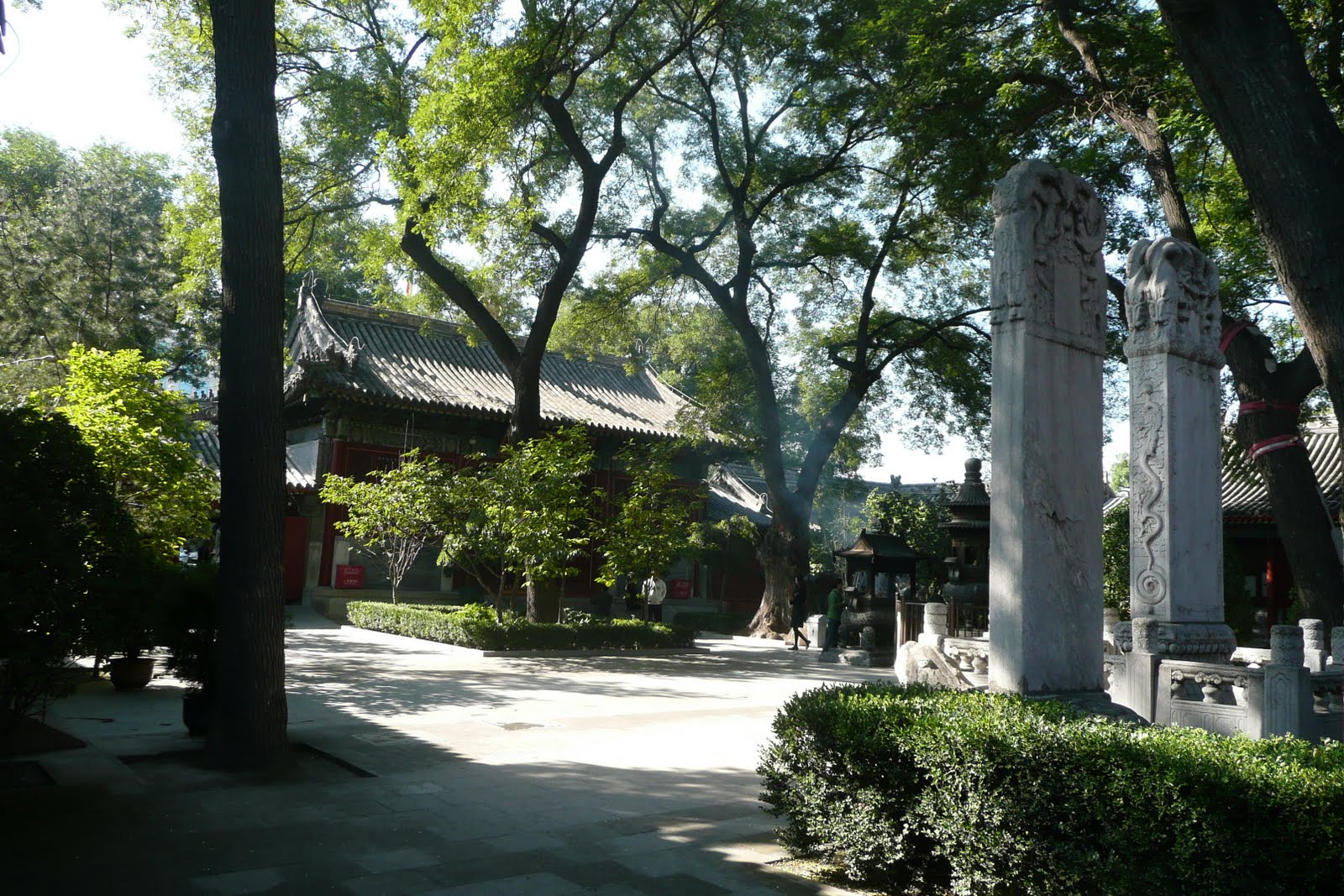
...to find yourself at a temple complex.

There's a bunch of renovation going on, and it's very crowded between the construction fences with all the people lighting their incense and so on.
At the top of the hill there is an old pagoda that doesn't seem to get much attention.

Well, since you're here, you can't really choose not to go down to Buddha's feet. You start out level with his head.

At the top you can look down.

Yes, it's a long way down.
This is what it looks like about halfway down:

And near the bottom you get a good look at the massive feet.

When you get to the bottom and look up, this is what you see:

When you go out the other side and climb the stairs back up the cliff, it gets kind of confusing. We entered a separately ticketed area which was covered by our everything passes. We walked a long way along a path and saw something kind of curious.

As some kind of good luck charm or something, people wedge sticks into every possible crevice. I don't know the significance of this.
Eventually you get to the cave of the Thousand Arm Guanyin

This is followed by a whole bunch of carved Buddhas, all replicas of famous shrines around Asia, including some from Japan and India.

In English, the name is something like The Asian Buddha Theme Park, but it doesn't seem to have any rides. I think it would be great if if did. Imagine learning some of the famous stories in 3D seen from a hurtling roller coaster!

If you noticed that's not Buddha, give yourself a gold star. It's Shiva, in a replica of a famous statue in India. It may be a Buddha Park, but they're not too strict about what is allowed.
After returning from the Buddha Park to the main park area, we wandered around trying to figure out how to get to something new. The maps were very confusing, and there was no clear best path. We saw a few more temples and ended up at the main exit.
We hopped back on the #13 bus and rode past one of the things we had tried to find in the park, a famous bridge.
 Notes on getting around:
There is a frequent bus between the New South Gate Station (新南门站 Xinnanmen Zhan) in Chengdu and Leshan for ¥43. Leshan city bus 13 will take you to the dock where you can get on the boat (there are several different companies offering what seems to be the same service for ¥50). After you get off the boat, route 13 will also continue on to the Great Buddha. The Leshan city buses are kind of run-down compared to the Beijing buses I've ridden, but they offer a great inexpensive (¥1) way to see a bit of the city as you ride around the streets. When you leave the Great Buddha park, cross the street and catch the 13 bus back into town – it will take you right to the bus station. I do not recommend buying the added ticket to the Asia Buddha Theme Park unless you really want to see a bunch of replica statues.