Showing posts with label cats. Show all posts

2011/03/01

A temple in my back yard

This post covers things I saw on 5 October, 2010.

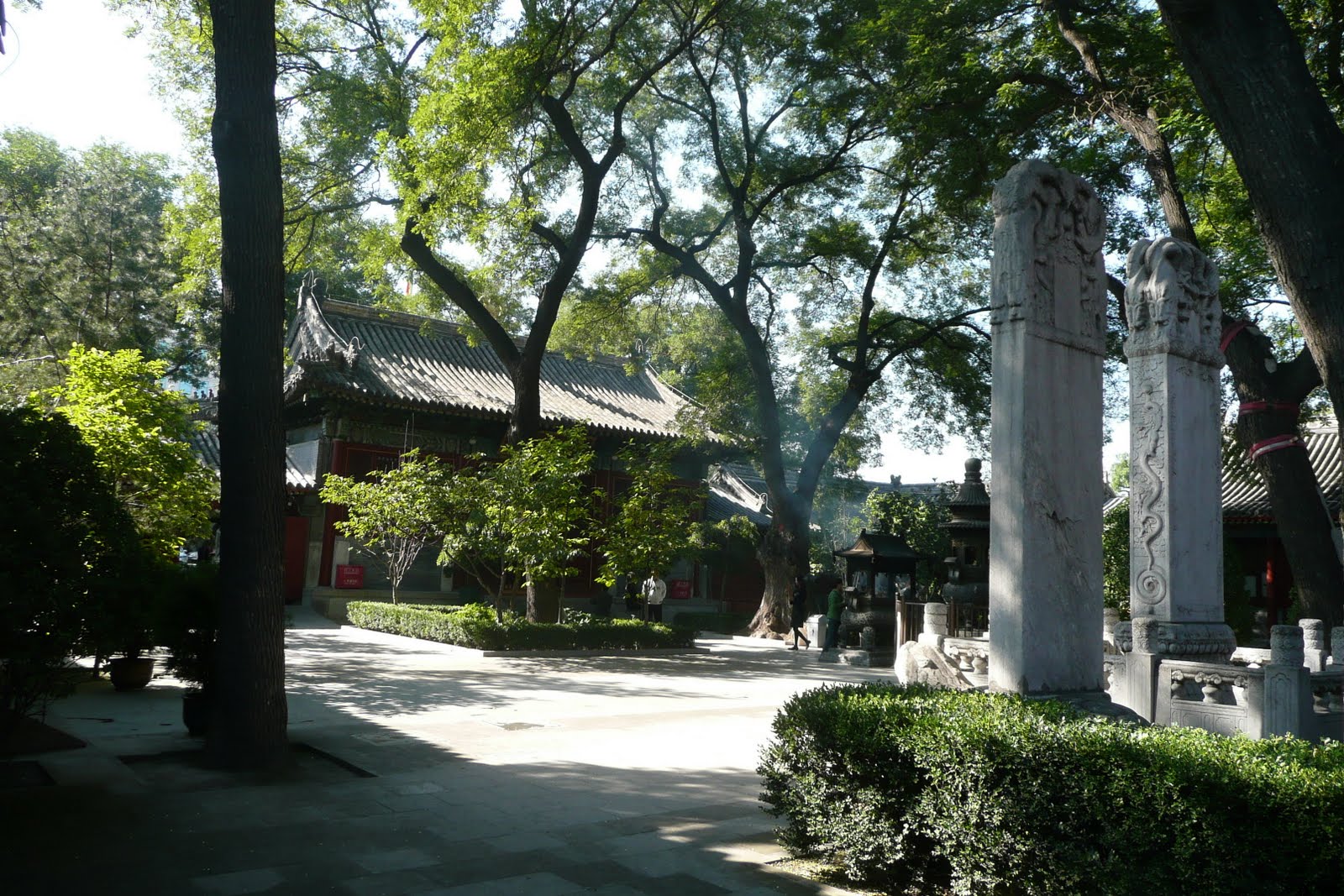
Several times each day, I would walk between my hotel and Line 4's Xisi Station. Eventually I noticed that over the construction fence there were some golden-tiled roofs, which usually indicate something interesting.


So I walked around the corner and found the entrance to 广济寺 (Guangjisi), which is a Buddhist monastery and temple. Entrance is free.


As with the other temples I've visited in Beijing, it is somehow insulated from the hustle and noise of the busy street just outside its walls, creating a little island of peace and tranquility.


One difference between this and most of the other temples in Beijing is that this is an active religious facility, not just a historical relic. It is the home of 中国佛教协会 (the Buddhist Association of China).


It's not a very big temple compared to something like the (The Temple of Heaven), but it's very nice in a humble way. One odd thing I saw there was a Buddhist nun wearing her robes wandering around in the parking lot, yelling loudly to no one in particular. I couldn't understand a lot of what she said, but she seemed to be complaining about things "they" were doing. If I saw a woman doing this in Seattle, I would assume a mental illness and hope she's getting treatment. On my way out, I saw a couple of civilians (not wearing robes at least) talking with her, apparently trying to calm her down.


It seems to be traditional that temples have cats, and my personal tradition is to take pictures of them.

2009/05/27

Chinese time machine #5

Moving back even further – though not a lot – we come to 15 February 2009. It was clear and very cold in Beijing, but I chose to venture out to Daguanyuan (大观园), which I’m not even really sure how to translate. The English maps give it as Grand View Garden, which will apparently do.

One thing about this place that is unique among all the places I’ve visited in China is that it is not old, and not only is it not old, but it was built as a set for a TV series. It’s hard to explain the cultural importance of the book called 红楼梦 (Hong Lou Meng, usually translated Dream of the Red Chamber) to the Chinese. It is one of the Four Great Novels, and you probably would be hard pressed to find a single Chinese person not familiar with it on some level. In the 1980s, China Central Television produced a series based on the book, and instead of filming it on soundstages, they built an entire compound designed to match every description found in the book of the place where the main family lives. It’s the story of a prominent family in decline, so grandeur is called for.

Here’s the front entrance.
Yeah, it was February, so prepare yourself for lots of pictures with bare trees.

At Ұ55 (US$9), the ticket is a bit on the expensive side compared to a lot of Beijing sights.

There are many buildings arrayed around various water/ice features.
Helpful signs tell you what parts of the book involve the buildings, which character lived there and so on.
As you can see, they did a very good job of imitating the style of construction you see at the Forbidden City, the Summer Palace and so on.

Inside some of the buildings are figures dressed as the characters.
Most of the major characters in the story are women.
This compound within a compound is the nunnery where Miaoyu retired to a Buddhist life.

Here’s a view across the largest lake.
I’ve never before seen a sign that said “Keep off the lake” – though of course while it’s frozen solid, the meaning is correct. The Chinese is a little more verbose, and says that the ice is not safe, so please don’t go on the lake. I presume they change the sign once it’s not frozen.

Since the family in the story was highly placed in society, they had some special buildings made just for occasions when the emperor would visit.
Any resemblance to the Forbidden City is no coincidence.

Inside one building is a bunch of Red Chamber memorabilia.
These are photos of actors who have played the various parts in various productions of the story, not just the 1980s series that was filmed here.
And this kind of tree...
...is called a “Dragon Claw Tree.”

Some visitors are not impressed by elaborate buildings.
And for a price...
...you can dress in period costume and have your picture taken.

As I promised, you’ve seen lots of pictures of bare trees. It seems that such a situation is intolerable.
So the staff has provided some trees with a little help.

I guess there’s a new version of Red Chamber currently in production, and they had some promotional posters of the new cast.
I’m hoping that for the actual filming, they will have more authentic hairstyles.

There you go. I think about when I’ve visited Universal Studios, and it’s kind of hard to imagine sets like this ever being built for an American production.

Daguanyuan is in the Xuanwu (宣武) District of Beijing, not a long taxi ride from Changchunjie Station (长椿街站) on subway line 2. It is certainly not on the short list of Beijing places you must see unless you are a Chinese literature buff or maybe interested in TV production, but it was interesting, and I’ve already seen the things on the short list. There is also an underground theater at Daguanyuan where they show a computer animated 3D short feature that involves a dream in the Red Chamber. A character falls asleep and drifts through various scenes somewhat resembling events in the book. Or so I’m told – I haven’t read the book yet.

2008/11/12

Back in the U.S.A.

In a departure from the normal topic of China, this time I’ll share a few pictures from my recent trip back to the US. I took the direct flight from Beijing to Seattle on Hainan Airlines, which saves a lot of time compared to even the Air Canada route via Vancouver.

The first few days I was home, the weather was reasonable. Here’s a clear day view from our front deck.
I promise if you look really closely you can see a bit of water between the trees. That’s something you can’t get in Beijing (and I’ll leave it to the reader to decide whether I mean the water or the blue sky).

This is a cat named Baby.
She is not a skinny cat.
No, the cat in the picture above her is not her, but another cat with a strong resemblance.

When she gets a chance, she likes to hang out in the yard.
Speaking of the yard, there were a few dahlia stragglers still in bloom.
And speaking of cats, here’s the other one, generally called Pele.
Here’s one of the parts of the house in Seattle that I miss:

Another highlight of the trip was seeing Sam Phillips at the Triple Door. This is a really nice club in Seattle where they unfortunately keep the lighting really low.
She is one of my favorite singer/songwriters, with a wonderful expressive voice.
She’s a pretty good guitarist too, and plays both acoustic and electric. And in case you’re wondering, that other instrument is a Stroh violin.

Her drummer also used uncommon instruments.
Here he’s holding a drum in one hand and hitting it against his leg while he plays a cymbal with his other hand. He also had a tambourine strapped to his ankle and a table full of various objects to hit and shake.

One of the fun things she did was for the song “Animals on Wheels.”
She was accompanied by a piano recorded on a microcassette which she held up to the microphone.

And all too soon, the stay in Seattle was over (though I’ll admit to being tired of the rain), and it was time to return to Beijing.

Here’s a rugged part of Siberia we flew over.
Here in Beijing, winter has definitely started its inquiries, and will soon be moving in. After a couple of cold nights, I got my heat turned on, so all is fine now at home.

While I was away, those of my coworkers who are still with the company moved into a temporary office space at The Place, which I’ve written about before:
At the moment, we’re all on folding tables crammed into one room.
That picture was taken with my BlueBerry, so excuse the quality.

Sometime next month our permanent office should be ready. It’s also at The Place, in one of the other towers.

2008/10/11

No reservations, part 3

Back to part 2.

2008-10-06


Once it was daylight, we saw we were passing through a mixed agricultural and industrial area. Corn dominated.
Around 7am we arrived at Pingyao. From here on out, we had no reservations for transportation or lodging. At the little train station, there were a bunch of taxis, which in Pingyao are mostly either open electric golf-cart-like vehicles or three wheeled things kind of like modified motorcycles. We found one and asked him to take us to a hotel in Gucheng (the Old Town), haggling for the price until he agreed to ¥2 per person. It was not a long ride, but it was really cold in the open car.
Once we passed inside the city wall, we could see why there were very few full-sized cars as taxis. The streets are very narrow and mostly dedicated to pedestrians, bicycles, and scooters along with the taxis. There are barriers preventing any wheeled vehicles from proceeding, and if you’re on a bike you have to pick it up to get past.
We paid the driver and looked at the first hotel, then three others. Actually they’re called guest houses, and are not really like a standard hotel. There are a bunch of them around the old part of town, just as there were in Lijiang.
We settled on the second place, which for no reason I could tell, was called the Catholic Guesthouse in English (the Chinese is 永庆斋客栈 Yongqingzhai Kezhan, which has nothing to do with religion as far as I can tell, something like Perpetual Festival Guesthouse), and they agreed to let us stay for a ridiculously low price.
We got two rooms like this one for two nights for a total of ¥100 (a little less than US$15). Right, that is ¥25 per night per room.
It had a Western style toilet which was a bit old and stained, but worked just fine. What we didn’t check was the hot water. Apparently they claimed hot water was available 24 hours.
These guest houses all feature at least one courtyard, and are basically repurposed old buildings.

So we checked in (and they never had me fill out the government’s foreigner temporary residence form), dropped off our bags, had a quick breakfast there, and went out to take care of our first order of business.
We rented four bicycles for the day, and rode off to the train station to arrange for the next leg of our journey.
This is us discovering that there were no seats available for any trains to Datong on the 8th. Well, there’s always buses, right? We asked direction to the bus station, and rode there to see if we would have better luck.
As it happens, bus tickets can only be purchased on the day of travel, so we checked out the schedule and prices, and headed back towards the Old Town.

We passed through what you might call Auto Row, where a bunch of new and used vehicle sales and repair shops were located.
This type of vehicle seems to be the area’s equivalent of the American pickup truck: the farmer’s general purpose work and delivery machine. We saw them all over the place, sometimes loaded with truly amazing cargoes. There are also electric versions, including many outfitted as taxis.

Aside from its Old Town, Pingyao is famous for a type of preserved beef, so we rode to the factory store for the most famous brand, but all the staff were on their lunch break and the store was closed. While we stood around discussing what to do, one of the sellers came and let us in for a look. My companions bought a couple of boxes for gifts, and I agreed to take one bag myself.

Then it was back to town to drop off the boxes at our rooms.
This is the outside of the West Gate.

Then we rode around town to get a feel for where things were, and to find lunch. Just down Nan Dajie (South Street) from the Catholic Guesthouse is Shilou, sometimes called the Bell Tower, though the Chinese just means City Tower.
Pretty soon, one of the themes for the Pingyao portion of the trip made its first appearance.
There are lots of cats in this town. It seemed that about half of the shops had one or more hanging around somewhere, even curled up in the display cases.

For lunch, we wanted to try out some of the local specialties, so we picked a restaurant and ordered some.
On the far side are some fried balls (“poms” on the menu) filled with figs and red beans, sweet and gooey and tasty, if a bit greasy. And watch out for the seeds! Then there is a noodle dish that was pretty good, and a soup with tofu and fatty pork (bacon, essentially).

After lunch, while my companions were busy haggling at a jewelry stall, I rode the short distance to the South Gate.
This was the city’s main gate in its heyday. I think the area just inside it here was where the guards were garrisoned. During the middle of the 19th Century, Pingyao was the banking center of China, with several large nationwide banks headquartered here, and that great wealth made the city a showpiece of Chinese culture at the time. However, once the imperial situation started changing around the turn of the 20th Century, the banks didn’t adapt, and within twenty years, had all failed, reducing the city to a quaint backwater. And fortunately for us today, leaving it untouched by modernization. With the troubled banking situation in the US right now, it makes me wonder...
After the jewelry shopping was done (at least for the moment), we continued our ride, and came across something not listed in the guidebook.
This Christian church near the East Gate is still in use.

Along the inside of the eastern wall, you can see that behind the brick facing is a pile of dirt.
And you can see another of the wide variety of vehicle designs in use. And speaking of vehicle designs...
These larger three-wheeled things are very common as well. You can’t see it from this angle, but the engine is between the two seats, and it uses a belt to drive the rear axle.
We rode around the inside of the wall from the East Gate around to the north and discovered that the east side of town has very few tourist attractions. Just normal everyday life over here. That’s a pile of ears of corn set out to dry.
And that’s a pile of coal in the street with buckets to carry it inside for heating and cooking.
By the time we returned the bikes, it was after dark.

For dinner, we went to a somewhat more upscale place that was recommended in a guidebook. There was a guy in an old-fashioned costume who beat on a drum and announced the arrival of customers.
You can tell it’s upscale because the dishes all match. On the left is a local snack consisting of mashed potatoes formed around a stick and deep fried. You dip them into either the sweet sauce or the spicy salt powder. Interesting, but not outstanding. At the back is a chicken and vegetable dish that was good, and nearest is a nice eggplant dish.
I had been fighting off a cold for several days (living on Sudafed and Halls lozenges), so didn’t feel like a late night (and honestly, Pingyao does not have a bar scene like Lijiang does). We went back to the Catholic and arranged for a driver to take us to a site out of town in the morning.

Continue to part 4.