Showing posts with label work. Show all posts

2009/07/30

What I like about you (from the other side)

Only one day left until I leave Beijing, and already the apartment is getting echoey. I’ve given away a bunch of stuff, and packed other things. The movers came yesterday and took away many boxes – I’m really glad I didn’t have to do it all myself.

Before I left Seattle, I made a list of things I thought I would miss and not miss about the city, so now it’s time for the same list about Beijing.

Things I will miss about Beijing

  • My friends.
  • The food, both in quality and price. And it’s cool you can have roast duck without planning ahead.
  • The ancient culture that is never far away.
  • Ease of transportation. Between my bicycle, the subway, and buses, getting around is generally quite convenient, even with the ridiculous traffic.
  • The chance to practice speaking Chinese with native speakers every day.
  • How amazing it can look after a good rain.
  • The sense of freedom you have when you don’t have to worry about crime.
  • How cheap things are if you’re looking for cheap things.
  • Having someone come clean the apartment twice a week.
  • The challenge of trying to think of ways to explain English words and expressions.
  • The vibrant music scene and all the great bands here, plus the ones I haven’t discovered yet.

Things I will not miss about Beijing

  • The quality of the air, and I’m not just talking about the odd odors that sneak in occasionally when the breeze changes direction.
  • The bone-chilling winter temperatures.
  • The energy-sapping summer temperatures.
  • The Great Fire Wall.
  • The ridiculous traffic.
  • Office politics.
  • The hideous desk my landlord provided for my computer.
  • The hassle it can often be to deal with seemingly simple things like electricity, mobile phones and internet.
  • Having to register with the local police station so they know where I am.
  • The feelings I have on the occasions when I do think about politics.
  • Never really understanding what’s going on, even when I think I do. Not that this is necessarily different from the situation in the US...

In a very unusual bit of luck, I have never really experienced one of the famous Beijing spring sandstorms, so that didn’t make either list.

Final note

I created this blog when I found out I was coming to China, and now that I’m leaving, I’m not sure what I want to do. In the interest of keeping it to its topic (not that I’ve stuck to it strictly so far!), I don’t really want to continue writing about my life as it involves things other than China. However, I still have lots of China experiences and pictures I haven’t shared, so there’s material for many posts waiting for me to have the time to take care of it.

2009/06/26

天下没有不散的宴席

天下没有不散的宴席
tianxia meiyou busande yanxi
In this world, there is no endless banquet.

That saying is the Chinese equivalent of “All good things must come to an end.” And my time in China has been a Good Thing. Sadly, but not entirely unexpectedly, it is coming to an end soon.

One of the major topics of conversation here, as everywhere, is 全球经济危机 (quanqiu jingji weiji or Global Economic Crisis), and I suppose I can consider myself a victim of the Global Economic Crisis. Every day in Beijing we hear stories about businesses that cater to foreign residents falling on hard times. The number of foreigners living and working here seems to get smaller and smaller as companies conserve their resources by not supporting expats. Admittedly, we are expensive. Our packages generally include housing and living allowances that are quite generous.

As it stands today, my departure date has been set at July 31, but beyond that very little is clear. I’m taking things a day at a time and trying to enjoy what is left here, checking things off that list I kept in my head of things I wanted to do in China.

Like so many things in life, this is a mixture of good and bad. I love Seattle, and will be happy to return to family and friends there, as well as the clean air and all the wonderful things the city has to offer. But I will certainly miss Beijing, this crazy, crowded, incomprehensible city that I have also come to love. The experiences I’ve had here, and the friends I’ve made, have been such a benefit to my life that I can’t put it in words. Yes, me, the one who always has words, is left with no way to describe this. But one thing is certain: I cannot imagine that my life will not bring me back here sometime, somehow. Whether it is business or pleasure, I will be back.

2009/02/02

Work it on out

Since I came to China, I have worked in four different office spaces, and by a really odd coincidence, every time the company has moved, I have been out of town. When we moved from the Huabei Hotel into the G-Box I was in Japan, and they moved from there into a temporary space in The Place’s north tower while I was back in the US at the beginning of November last year. The latest time was while I was in Hawaii for Christmas. We relocated to our permanent office in the south tower at The Place.

When I first saw the new space last November, it was bare concrete with some walls.
That’s the future reception area.
And I think that’s the Call Center – kind of hard to tell. They’re using the area to build some of the custom fixtures. The one in the middle will be the reception desk.
This area would become my work space.

And here’s one more illustration of Chinese construction techniques:
Conduits for writing run across the building’s base floor, and channels are being built for more wires – network, phone, and so on. Notice how one set of conduits goes underneath the other, with the cement chipped out to make room.

When they’re done with the wiring, this pile of cement…
…will be mixed with water to fill in a new floor up to the level of the channel edges, then flooring will be placed on top.

Anyway, when I returned to Beijing it looked like this:
And this is about the same view as in the third shot above:
My work area is a little cramped.
My cube is the back left. If I’m not careful when I roll my chair back, I bump into RR, and the guys in the front cubes have to scoot in to let us pass.

Compare my G-Box desk:
Can I cry now?

For reference, this was the Huabei office in the fall of 2006, with my desk on the left:
And here is a picture of our temporary space I took with my BlackBerry from my seat. The Call Center is at the back of the room.

Back to the present, one last shot... we’re on the sixth floor, even with the Skyscreen.
That’s looking west, showing the back of the big TV screen facing Dongdaqiao Street and the edge of the Skyscreen running along the length of the building.

2008/10/11

No reservations, part 1

Introduction

When I travel, I normally have things planned out to a fair degree. I have reservations for transportation and lodgings, and sometimes even for specific sights that require them. This is a story of the opposite tactic.

A few weeks ago, as the week-long Golden Week holiday approached, everyone in the office was talking about travel plans. Most of them were going to visit their hometowns, and they told many tales of difficulty getting train tickets. With the improving economic situation here, hundreds of millions of people all want to travel at the same time. The government has instituted measures to try to spread out the rush a bit, but so far without much effect. But when I was asked, I had no plans.

Then I was talking with a former coworker (with the end of the Olympics and reduction in our staff, I have a lot of these), and she was talking about visiting her home province of Gansu, but at the end of the holiday instead of the beginning. There would probably be fewer people on the move at that time. I’ve seen pictures of the area around her home town and said, “Wow, that’s amazing. I should go along!” So we started tentatively thinking about a trip.

But it turned out Gansu was just too far to go. We started looking at alternate destinations. Hangzhou and Suzhou? Qingdao, maybe? Then she remembered a place I once told her I wanted to visit, the big Buddhist carvings at Yungang Grottoes in Shanxi. It seemed like the right combination of distance (roughly eight hours by train) and desirability. A little bit of research added another Shanxi destination to the list, and we had a vague 4-5 day itinerary. And two of my friend’s old college classmates from Gansu who now live in Beijing signed up to come along. A friend of a friend who is a travel agent helped out with the train tickets.

Being a typical American, I packed for five days, with five changes of underwear, five shirts, a couple pairs of pants and so on.

I’m a big fan of Anthony Bourdain’s TV show No Reservations, but I’m well aware that its title is misleading. He’s traveling with a TV crew, so of course he has everything worked out in advance when he goes somewhere. He has a local guide and translator, he has the restaurants picked out, he has a schedule to keep. But still, his philosophy (Be a traveler, not a tourist) is appealing, and if he can’t completely live up to his title, maybe I can try to. For one trip at least.

So here begins a series of posts that are much longer and more detailed than my usual habit. I hope you enjoy them.

Continue to part 2.

2008/05/11

Chop suey

As it happens, chop suey doesn’t seem to exist in China. I’ve read something about the name translating as “mixed bits” or something like that – it’s not Mandarin, probably Cantonese. Anyway, the title is chosen in the hopes that it really does mean “mixed bits” since it’s one of those miscellaneous scattered posts without a single theme.

Come 1 May I discovered that my internet connection didn’t like my password anymore. It hasn’t happened in a while, but my landlord forgot to pay the ISP again. It’s not like I needed any excuses to stay at the office long hours. And the internet at the office is slower for many things than my connection here.

Today’s topics include work, food, Chinese (the language) and Chingrish. Oh, yes, and harmonicas.

Phase 1: Work

The reason it’s been busy at work lately is this. Things went much better than last time, and we managed to sell more than a half million tickets in the first day, which may very well be a feat no ticketing company has ever accomplished. Around 5pm the day before, we started hearing stories about people queued up at Bank of China branches for the 9am opening. Those of you who have purchased tickets in the US and Europe will no doubt know that buying online is a far better option, but the system was set up to give a fair chance to people without computers or access to the internet.
Our Help Desk was up to full strength all day, answering questions coming in from bank branches. This was a very noisy room.
We got two big boxes of food from McDonald’s and KFC to feed the crew.

Within the first two days, essentially all the tickets to events in Beijing had been snapped up, and only the events in other cities are still available.

OK, enough of that. On to...

Phase 2: Food

I’ve mentioned a dish called jinjiang rousi, and my description brought on a request to see what the it looks like. Well, here it is, TC. It’s the one on the right.
It’s pork cut in thin strips (rou means meat, and si refers to this style of cutting). Jinjiang is the sauce, apparently. I don’t know what the word means. I’m told it’s a Beijing specialty, possibly of recent invention rather than a traditional dish like roast duck. The sauce is not spicy, but savory, and quite similar to Peking Duck sauce. Soy sauce is likely a main ingredient. Under the meat you find some thread-cut onion, just as with duck. The wrappers are made of bean curd, essentially thin dry tofu. You roll up the meat and onion in the wrapper and eat it, which can be a challenge with chopsticks even for an experienced user.

The dish on the left was some kind of lettuce in a nice sesame flavored sauce. In the middle is chicken with cucumber and a tiny amount of red pepper.

That was one day’s lunch. On another day, a coworker told me she really wanted to have kaoyu, roast fish, from a restaurant on Gui Jie. I think I’ve mentioned Ghost Street before – it’s the nickname for one of the major streets that lies between the office and my apartment. It’s a little further than we usually go for lunch, but for kaoyu you make the effort.

We got to the restaurant before noon and were the first ones in there. This might normally be a warning sign that the food isn’t very good, but my companion had eaten there before and assured me it would be worth it. There were four or five different kinds of fish on the menu, sold by the kilo. We picked one that cost ¥38. Then you select what kind of sauce you want from four-pepper spicy down to mild. We picked the spiciest one. Then you pick what will be roasted with the fish, and we got some greens and mushrooms. A couple of bowls of steamed rice, and there’s your meal. The waiter brought the wiggling fish out for our approval in a net. It was about 3kg.
And here’s what it looked like when prepared. All I can say is yum. Definitely a meal to remember. I wonder if you can get this in America... In case you can’t tell from the picture, it’s covered with hot red peppers and garlic cloves along with onion and huajiao, the Sichuan flower-pepper I’ve mentioned before that has a numbing effect on the mouth. This taste, the combination of numbing peppers (ma) and hot peppers (la) is called mala, and it is quintessentially Sichuan. It was not the spiciest thing I’ve ever eaten, but it was up there, and oh, so delicious – surprisingly the spice did not overpower the fish and vegetable flavors. Feichang haochi!

This is what it looked like after a half hour or so:

Phase 3: Mandarin

In the midst of all the work, I’ve managed to continue my Chinese lessons. None of my coworkers who previously studied with me had time to join me, so I’ve got private lessons twice a week most weeks. I’m learning all sorts of things to stretch my poor brain, and I try to use them enough that they stick.

The really exciting thing – to me at least – is that I’ve finally progressed far enough to start learning to read and write some of those strange characters.
This is my textbook along with my little practice book and my pathetic scribbles. I’m sure the average Chinese third grader makes me look like an idiot, but you have to start somewhere.

One amusing thing is that when she gives me dictation (she says words and I write the characters), sometimes I do the writing on her mobile phone. She starts a text message, and I type in the Chinese. It’s easier than you might think. You type the phonetic spelling (pinyin) for each syllable, and the phone presents a little menu of all the possible characters. You use the arrow keys to pick the right one. That way I don’t have to worry about penmanship.

Phase 4: WTF?

I’ve come across two really wonderful examples of bad Chinese English lately, and unfortunately I was not able to get pictures of either one. I saw the first one while riding in a taxi. We were stuck in traffic, and I looked up from my Blueberry long enough to puzzle over the bumper sticker on the car ahead of us. Apparently the owner loves his or her dog. The blue sticker had the white outline of some kind of terrier and these letters.

WEET HIGFLANG WFTERRIER

I cleaned my glasses to make sure the letters weren’t getting mixed up with smudges, then I opened up a note on the Blueberry and carefully typed in the letters exactly as I saw them.

The other one was at a subway station. I saw a nice looking young woman wearing a pink T-shirt with big block letters on the back:

HOLE
LOTTA
LOVE

At first I thought her long hair was covering up the missing letter, but no. That’s what it said. I’ll just leave this one without further comment. Please believe me that I actually saw this.

Phase 5: The Nanguan Harmonica Club and Dance Auxiliary

I have noted before that I often find harmonica players in Nanguan Park. Heck, you only have to go back one post to find it. The other night I was walking home for the office after dark, and the music was louder than usual in the park, and there was a crowd of several dozen people gathered.

I counted eight harmonica players plus one guy playing a bamboo flute. There were two women in costumes dancing to their music. Tonight I got there just before the 9pm closing time, and there was quite a racket coming from the park. In addition to the harmonicas (I couldn’t tell how many, but there were at least three dancers), there were about a dozen people singing, complete with different parts for the men and women. And since too much is never enough in this town, there was a group across the pond dancing to pop music blaring out of a boom box, plus the recorded announcement that the park was closing, which was accompanied by an old pop tune I couldn’t quite place (the backing chords are a lot like “Moonlight Sonata”). Add that to the music I had playing in my earphones, and it was quite a sonic collage.

Stay tuned for some more adventures, including a (gasp!) touristy place.

2008/04/13

Walking in BJ

I walk around the city a lot.

I could probably have counted the number of times I had ridden in a taxi on my fingers before I came here, but since then it’s probably averaged almost once per day. Not that I take a taxi every day, but there are plenty of days with multiple rides to make up for the days with none. Given how cheap they are here, that’s not really a problem financially like it might be in New York, for example. But I’m just really tired of taxis.

I got myself a Beijing transportation card which is good on subways and buses, and I use both of those to get most places. But for shorter trips, say a half hour or less, I just walk. Like they say, ru xiang sui su. That’s the Chinese equivalent of “When in Rome, do as the Romans do.”

And I usually have my camera with me. Won’t you join me? (Why do I feel like Mr. Rogers all of a sudden?)
The trees here at Season Park are in bloom.
On the way to the office, I pass a shopping mall where lots of people just hang out, with or without their dogs.
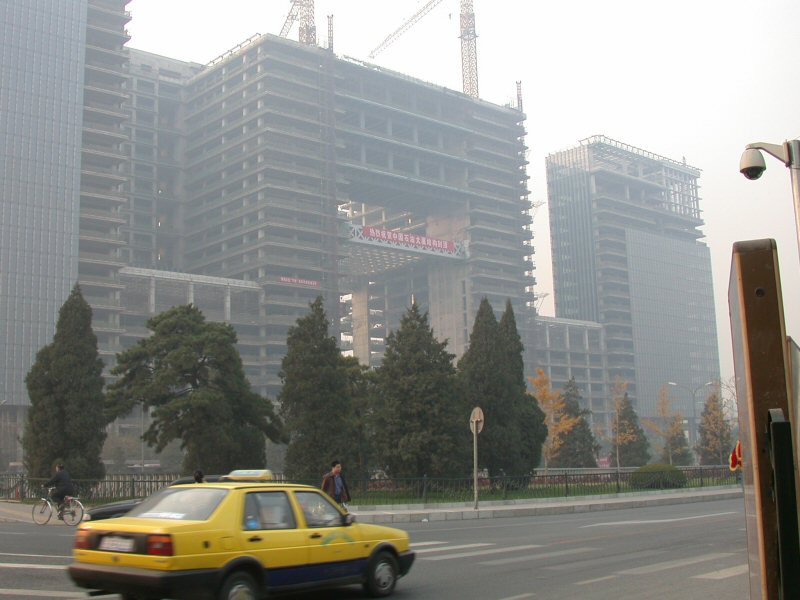
I pass by the Dongzhimen Transit Center, still under construction. I don’t know why it’s so massive. Three subway lines cross underneath it, and about a hundred bus routes, but I have no idea what it will look like when complete.
Across the Second Ring Road from the Transit Center is this big office building, which I’ve photographed before, back when it was less complete:
That's from November 2006.
A little further along I pass through Nanguan Park, where the pond is half-filled. Notice the Fuwa standing on the water.
Even on a weekday morning there’s a fair amount of activity in the park. The guy with a music stand under the tree is playing a harmonica into a little portable amplifier and a few people are dancing to his music.
Continuing along towards the office, I encounter this deconstruction site. I ate at this restaurant only last week.
Here’s my building, with one of the newer tenants visible. Finally, decent coffee nearby. Obviously, this company is trying to emulate a certain Seattle-based multinational coffee company.

Then a day at work.

I’ve been pretty busy lately, so I sometimes go to a nearby restaurant called Beijing Pastry and Congee for take away.
Here are three filled pastries called xianbing, two with spiced ground beef and one with chopped vegetables, and a cold vegetable dish called haidai made of seaweed cut in strips with carrots, peppers and a lot of garlic.
That’s the bill. It comes to ¥10, about $1.45.
After work, I head for the subway station, where I see a new advertising campaign has taken over. In case you can’t make it out from the picture, the slogan is: Protecting Intellectual Property Rights And Promoting Innovation Development. It’s sponsored by the State Intellectual Property Office of the People’s Republic of China. Note to all foreign businesses: your IP is safe here now.
I get off at a stop across town and walk into a neighborhood. Dozens of vendors, mostly fruit and veg, are set up on the sidewalk along the little street, and the gathered shoppers made it pretty difficult for cars to get by.

I hear a little peeping noise and look to see what’s making it.
I’m not sure if the chicks are supposed to be pets or livestock or sale goods, but for the moment they’re Free Range Chicks. I don’t hang around to see if they ever make it back into the box.
The guy on the left is welding something on the sidewalk. The woman on the right is washing some vegetables for dinner.

I meet up with a coworker in this neighborhood. And speaking of dinner, we go to a fairly nice place.
That’s supposed to be half a barbequed duck, but it’s kinda small for a half bird, and seems to be missing some parts you would expect, but it tastes pretty good. The restaurant is having a special: for every ¥19 you spend, you get a free 600ml beer. As you can see, we qualify for three. In case you don’t know your metric system, those are big beers, about the size of two twelve ounce bottles each. We end up only drinking two – one of them is still in my fridge. They don’t complain when I carry it out.

To be honest, this is a composite day, consisting of events and pictures from about three different days in the past week. But I think it gives an accurate picture of my life here, straddling the expat world and the local culture. Tune in next time, when I'll condense all the seasons into one week and a decade into a month.

2008/04/01

Ancient Chinese secret, huh?

How’s that for a cultural reference that dates me?

This is a short post about two surprises that happened today in quick succession.

Purely by accident, I discovered that Wikipedia is accessible in China. A friend told me she was moving to the city of Zibo in Shandong, so I did a Goggle search, and of course the Wikipedia link was the first result. Usually I don’t even bother clicking on those, but something in me said “What the heck?” and gave it a try.

Oddly enough, it came up – extremely slowly, but not the usual “Server not found” error. That was the first surprise.

Then, in the article on Zibo it said that FIFA has honored the city as the birthplace of football. Huh?

So there you go. The ancient game of cuju, played by both men and women in China over 2000 years ago is the ancestor of modern soccer.

Lately at work it’s been a kind of theatre of the absurd, and I really wish I could say more about it, but that story will have to wait until after the Olympics, if it can ever be told.

It’s been a year since I got my work permit, so that’s currently being renewed. I feel kind of strange not having my passport, but they can’t put a new visa in it unless they have it.

And I’m pretty excited that I’ll be resuming my language lessons next week. They’ll be private lessons this time, since none of my coworkers who took classes before seem to have time these days. I’m just going to make time.

2007/12/01

Willkommen in Deutschland

No, I haven’t made a sudden trip to Europe, though in some ways it seemed like it. On the first Saturday of December every year, the German Embassy in Beijing holds a holiday celebration. I missed it last year, but not this time.

I had to go to the office for a while in the morning, but finished what I had to do around 12:30 or so and took off. After dropping off my computer at home, I walked to Germany, which isn’t far from Seasons Park. It was hard to miss – it was the place with the big line of people waiting to get in.
I emailed JW that I was waiting in line, since I didn’t know if he was inside yet. I knew KW had been there for a while. When I was about halfway to the entrance, JW arrived. He called his wife, and she said she was waiting in the bratwurst line. He told her to get a couple extra, mustard only.
When we got to the gate, we could see KW waiting with our sausages. Embassy staff glanced at our passports (we were entering foreign soil after all) and we came in. The sausages were still warm. KW led us toward the beer stand.
For ¥50, you get a German beer in a logo mug that you can take home with you, or you can get the ¥25 deposit back by returning the mug. We all kept them.
Vegetarians beware!
CL showed up after a while, and we greeted him at the gate with more bratwurst. Here they are in the courtyard after a visit to the dessert table. Note JW’s bulging coat. He’s got about a half dozen beer mugs stashed in various pockets.
In the lobby – the warmest part of the whole place that we were allowed to go – there was a woman playing an organ. I suppose it must have been Christmas music, but I honestly couldn’t tell.
Say hi to the girls at the Getränke stand. As we walked past one time, they all started singing “Jingle Bells” in English. They didn’t seem to know the verses, only the chorus, which was fine by me.

It’s some kind of charity thing, with proceeds going to some Beijing area organizations. How’s that for a way to make people feel better about standing in the cold drinking beer?

As celebrations of Christmas go, this one beats last night. I went to a popular dim sum restaurant with a couple of coworkers, and the staff all wore Santa hats. For music they played “Here Comes Santa Claus” over and over and over. Good thing the place was so crowded and noisy, or it would have driven me to do something that might have got me kicked out of the country.

2007/11/17

Xuexi withdrawal

Xuexi (pronounced kind of like shweh-shee) means class or study. With things as busy as they’ve been at work lately, we’ve cancelled our twice-weekly Mandarin lessons until next month, and I’m really missing them. I’ve reacted by trying to study on my own and rely on my Number Two Teachers – namely my Chinese coworkers. By and large, they’re an educated bunch, and make pretty good instructors. Certain Mandarin-speakers back home have also helped.

Here are a couple of nifty things I’ve learned:

Luan qi ba zao. This literally means “mess seven eight waste” and is a phrase meaning “all messed up.” Apparently the number seven is associated with chaos in Chinese tradition.

Si zhu bu pa kai shui tang. A dead pig does not fear hot water. Think about this one, you’ll work out what it means.

Now, at the risk of boring my readers, I’m going to present one little observation about the Mandarin language. No great details, just a little tidbit I find interesting.

One of the first things you learn about Chinese is that there are no words meaning yes and no, which seems very strange to an English speaker. How can you possibly get along without such basic words? (Incidentally, I seem to remember Irish Gaelic is similar in this respect.)

Think about this: In English, the negative form of a question is always ambiguous in its answer.

Positive question:
Q: Is that your sister over there?
A: Yes.
Simple enough. But how about this?
Q: Isn’t that your sister over there?
A: Yes.
So is it the sister, or not? Strict proper logic says that an affirmative answer to a negative question means the negative, so it must not be the sister. But we all know that in casual English speech, it would actually be the sister. Smart alecks like me sometimes play with this ambiguity by deliberately answering questions so that the asker doesn’t know what you mean even though you answered correctly.

In Mandarin, any question, regardless of form, is answered with the fact.
Q: Is that your sister over there?
A: Is.
Or…
Q: Isn’t that your sister over there?
A: Is.
Isn’t would be the opposite answer. See? No ambiguity.

In a way this directness is ironic, since Mandarin can be extremely ambiguous in many other ways.
Q: Don’t you know this is enough linguistics for now?
A: Know.

2007/10/27

Milestones and musings

Some photos by me, some by D.

This Tuesday was my one year anniversary of moving to Beijing. I had planned to write an entry that day with some sort of thoughts upon reaching that milestone, but it turned out to be a ridiculously busy week at work, and I’ve been at the office until after 9 almost every night this week. As was announced just today, Phase 2 Olympic ticket sales start next week, and people in China will be able to walk into a participating Bank of China branch, or call the phone center, or go online, and purchase tickets without having to go through a lottery.
It’s astounding how much preparation goes into such an event, especially when you have as many moving pieces as we have here. There’s the software used at the bank branches and the phone center, which is different from what Ticketmaster uses in the rest of the world even aside from the Chinese interface; there’s the web site, which also for various reasons is different than TM standard; there’s making sure payment authorization works, making sure the money is reported accurately, making sure the internet connections work to all 1000 banks spread across one of the world’s largest countries, figuring out how many phone agents are needed, making sure there are procedures to deal with problems, making sure all the documentation is available in two languages... you get the picture.
So now it’s Saturday and I have a little quiet time before tonight’s indulgence in one of those odd culture clash experiences that seem to come along so often here. SJ has proposed a group dinner at Hooters. Yes, Hooters Beijing. More on that after I’ve been there.
What are my thoughts after one full year here?

• I’m tired. It’s been a lot of work, especially this week. If I think hard (or refer to past blog posts) I can see that I’ve obviously had some spare time to take in the experience. All of the excursions I’ve written about have been squeezed in between flurries of work.
• China is too big and too varied to sum up or even really wrap my head around. I suppose the same would be true of any large nation, but even among large nations China is in a class by itself (India probably comes close). And the country has such a bizarre (to Western experience) history that the obvious surface differences are the least of it.
• Most of what foreigners know, or think they know, about China is wrong. I’ll elaborate on this in a bit.
• As morally reprehensible as you might consider the One Child Policy, it has saved this country from almost certain disaster. There are plenty of places in the world where you can look to see what uncontrolled population growth does in an economy that cannot support it.
• My brain is still working its way free of the language rust built up from years of not speaking anything but English. It’s taking me much longer to pick up Chinese than with French or Spanish back in high school, or Russian in college. Admittedly my time was more dedicated to learning back then, and with only two classes a week things move slowly.
• Maybe it makes me a heretic to think this, but I don’t think American style democracy would work here. I think the Chinese people will find their own way to a better system, and if they can avoid the kind of money-grubbing political influence peddling that runs our government, they’ll be doing really well. For this country, most of the major decisions coming out of the top levels have been quite reasoned and sensible, and if they can knock down the rampant corruption at the lower levels, the future should continue to improve.
• Pollution is a massive problem. As I mentioned, the highest levels of the government seem committed to doing the right things, but those policies seem to run up against a lot of momentum in the form of old-guard party appointees and corrupt managers. Of course, similar momentum (powerful lobbyists and right-wing pressure) hinders clean-up efforts in the US and Europe as well. Do not think the planet is getting cleaner just because LA isn’t as bad as it used to be. Air does not respect borders.
• The filtering of the Internet is really annoying. I’m all for a harmonious society, but I can’t see how protecting people from Wikipedia or Rocket to China contributes to it.
• Chinese people are generally sociable and cheerful. They’re always gathering in groups to play cards, do tai chi, practice ballroom dancing, sing folk songs, sit along the sidewalk chatting, and so on. They laugh a lot, and I don’t always understand their sense of humor.
On the subject of Everything You Know Is Wrong: The other day I came across a piece written by famed Euro-travel guru Rick Steves about his trip to Shanghai in 2003, and I was struck how different his impression of the country was than mine. It’s only been a few years, and he was in Shanghai instead of Beijing, but even that can’t account for the disparity. He wrote:
People seem docile and resigned to follow the rules. Schoolteachers carry bullhorns. Workers don't organize. Cabbies give you back all the change.

Notice how he says the cabbies give you correct change as if it's a bad thing.
I don’t know how anyone who’s seen traffic in Shanghai could say that people follow the rules.

Here’s a typical example. You get into a taxi at the airport, and the driver heads out onto the expressway. There’s a big sign in Chinese and English telling you to buckle up. The driver is not wearing his seat belt. As you approach the toll booth, where police are stationed, the driver reaches over and pulls the seat belt across his lap, but does not latch it. From outside the car, it appears as if he’s wearing it. Only twice in the hundreds of taxi rides I’ve had did I actually see a driver with the seat belt latched, and only once has one asked me to buckle mine. And while the legitimate taxi drivers have for the most part been scrupulously honest, there are plenty of bogus cabs around, and when the police see them, they just ignore them. At the Summer Palace, D and I waited for a taxi to go home, and there was an officer managing the queue. When we were next in line, a bogus driver tried to coax us into his car, right there in front of the policeman. The cop looked at me and wrote the jing character (as in Beijing) and the letter B in his palm; I replied “Wo zhidao (I know)” – legitimate Beijing taxis all have license plates that start Jing-B, and that car was Jing-E. Other impatient foreigners got in, and the cop shook his head with resignation. We got in the next real cab.
In general, rule-breaking is developed to a fine art here. Obviously, there is a large police presence here, and soldiers can often be seen around the city (it is a capital, and there are guards at all the embassies), but everyone seems to instinctively know just how much you can get away with.
Littering is so common that it seems the norm rather than an aberration – after all, there will be a person with a broom along in a few minutes to clean it up. People cross the street at virtually every possible spot, even climbing over barriers to dodge between cars. City buses run red lights and block intersections all the time. Getting away from traffic, no one lets the NO PHOTOS signs in temples or stop them from snapping away. You often see people barging past ticket takers without having proven they paid to get to the subway or the temple or whatever. And they yell and argue with policemen who try to tell them what to do.

And then there’s the bootleg CD and DVD situation.
• On the street and in small shops, CDs and DVDs cost the equivalent of $1.30 or so per disc, and most of them have quality equal to what you’ll find in the rest of the world. You occasionally get a bad one, but at the price, you just toss it and try again.
• In the major shops, many CDs and DVDs sell for about twice the street price, though some approach the price you’d pay in the US. I assume these are legitimate – what else can I do?
• Given the average income here, if DVDs cost $15, very few people could afford them.
• Given the fact that the “legitimate” copies have all been subjected to government editing, most people prefer the bootlegs, which are the full international versions.
• Maybe an expert can tell the difference between a good copy and a legit disc, but I can’t. They’ve got the little holograms and everything.
• Given all these factors, it’s no surprise that the vast majority of Chinese people prefer to buy bootlegs over legitimate products.
• What kind of massive, repressive police action would it take to thwart the honest preferences of a billion people? Might the cure be worse than the disease? It’s ironic that western business interests, while they purportedly champion freedom and democracy, are actually encouraging the Chinese government to increase its control of citizens.
• How will it work out, and what would be the best solution? I don’t know, but maybe the real future of intellectual property policies will be decided here by ordinary people rather than in corporate boardrooms with investments to protect.
And that’s about as much trouble as I want to create today. I’ve been sitting at my desk all morning catching up on these posts, and I feel the need to do something else for a while. One final thought: it is again that time of year that is after the weather turns cold but before buildings can turn on the heat. Just as it was when I first moved into this apartment almost a year ago. Time to get out the long underwear and flannel pajamas, drink hot beverages, and walk around with a blanket draped over me.